Catherine Howard Was Never Tried. Parliament Wrote a Law Instead.
October 30, 2026 · 8 min read
Ask what happened to Catherine Howard and the answer comes back in one shape: she was found out, she was tried, she was beheaded. The dramas stage a trial because a story like hers seems to require one, and because her cousin Anne Boleyn had one in 1536, in the King's Hall of the Tower, before twenty-six peers.
Catherine had no trial. Between her arrest in November 1541 and her death on 13 February 1542 she never stood before a court, never heard an indictment read, and never answered a charge. She was condemned by Act of Parliament, a bill that passed the Lords and the Commons like any other piece of legislation, and that Act did a good deal more than condemn her. It wrote three new treasons into English law. It was accompanied by a second statute making it lawful to execute a woman who had lost her reason in the Tower. And it contained a procedural clause, drafted so that Henry would not have to listen to his wife's death sentence being read, that outlived every other word in it by four centuries.
I spent a book on Catherine Howard, and the Act turned out to be the part of her story nobody had told me.
Why there was no trial
Attainder was not invented for her. Parliament had been condemning people by statute since the fifteenth century, and Henry's reign had made a habit of it. Margaret Pole, Countess of Salisbury, was attainted in 1539 without being heard and beheaded on Tower Green in May 1541, eight months before Catherine's bill was drafted. Thomas Cromwell, who had helped make the device respectable, was attainted unheard in the summer of 1540 and executed on the morning Henry married Catherine. By the winter of 1541 the English state had a well-worn way of killing a person of rank without a jury, and a queen was the kind of defendant for whom a jury was most to be feared. Nobody intended to give Catherine the chance.
There was a second reason, and it is the one that makes the Act strange. Most of what Catherine was accused of was not a crime when she did it. Her years in her step-grandmother's household at Lambeth, the music teacher who pursued her around 1536 and the gentleman who called her his wife around 1538, were the matter of the paper Archbishop Cranmer left for the king on All Souls' Day; and an unchaste past was not treason in November 1541, nor was keeping quiet about it. The two men were tried at the Guildhall in December on a theory of intended treason and died at Tyburn. But for the queen herself the law as it stood did not plainly reach what the council had found, and so Parliament was asked to do two things at once: declare her guilty, and define the guilt.
What the Act said
Parliament opened on Monday, 16 January 1542, with the king present. The bill against the queen was read in the Lords in the third week of the month. It is the twenty-first chapter of the statutes of the thirty-third year of Henry VIII, and it has three parts.
The first is a narrative. The Act recites the case against Catherine at length, in the form of a story: her life before the marriage, the king's ignorance of it, the meetings with Thomas Culpeper, Lady Rochford's part in arranging them. It is the longest surviving statement of what the crown wanted believed, and it is advocacy, not evidence. Much of what later biographers treated as settled about Catherine comes from this preamble, read as a finding rather than a pleading.
The second part is the attainder proper. It declared Catherine and Jane, Lady Rochford, guilty of high treason and condemned them to death, confirmed the convictions of Culpeper and Francis Dereham, and dealt with the Dowager Duchess of Norfolk, indicted in December but never arraigned with the rest of her household, for concealing what she knew.
The third part is the reason the Act deserves a chapter rather than a footnote. Having told the story, Parliament provided that it should never happen again. If the king, or any successor, meant to marry a woman he took to be, in the statute's words, "a pure and clean maid," and she was not, she was to tell him before the wedding; if she married him without doing so, she was guilty of high treason. Anyone who knew of such a woman's past and did not disclose it to the king or the council, before the marriage or within twenty days after it, was guilty of misprision of treason, the lesser offence, punished by forfeiture and imprisonment for life. And a queen, or the wife of the king's heir, who moved any man by message, word or writing to commit adultery with her was a traitor, as was any man who moved her, and anyone who carried the messages. The clauses named no one. They did not need to. Every reader knew who the concealing woman was, who had known and said nothing, and who had carried the messages.
Catherine Howard
The second statute
Lady Rochford had broken down within days of her arrest. The imperial ambassador, Eustace Chapuys, reported that the king sent his own physicians to her and that she was moved out of the Tower to be cared for. His information was second-hand; nothing in the record allows a diagnosis, and the plain reading, that a woman whose husband had been beheaded for treason six years before collapsed under interrogation and the near certainty of death, is the one the evidence supports.
The collapse created a legal problem. The common law did not permit a person who had lost their reason to be tried or executed. So the same session passed a separate Act, the twentieth chapter, which sits in the printed statutes directly before Catherine's attainder. A person who had been examined before the council and had confessed to or been charged with treason while of sound mind, and who afterward fell into madness, could be proceeded against, tried in their absence, and executed as if sane. It was drafted as a general law. It was passed because of one woman, and so far as is known it was never used for anyone else in Henry's reign. It is usually said to have been repealed under Mary, though the authorities are less sure of the repealing statute than that bare statement implies.
The clause that outlived them all
Royal assent was normally given by the king in person, sitting in the Lords, with the clerk pronouncing the old French formula over each Act. When the attainder bill was in the Lords in late January the peers proposed two things, and the king accepted both. One was that a deputation should go to Catherine at Syon, so that she was not condemned entirely unheard. The other was that the king should be spared having to sit through the matter when the bill was passed.
The deputation went in the first days of February and brought back her submission: she acknowledged that she had offended, said that she deserved death, declined to defend herself, and put herself on the king's mercy.
The second request needed a mechanism, and the drafters wrote one into the Act itself: a clause declaring that assent given by letters patent under the great seal, signed by the king and read before both Houses, was as good as assent given in person. On Saturday, 11 February 1542, commissioners including the Lord Chancellor stood in the Lords and declared the king's assent to the bill condemning his wife. Henry was not there. Catherine had been brought by barge from Syon to the Tower the day before. She died two days later; a merchant named Ottwell Johnson, who was in the crowd, wrote that she called her sentence just and asked the people to pray for the king. Lady Rochford followed her onto the same scaffold.
Assent by commission did not go away when the grief that excused it did. It became ordinary practice for most Acts of Parliament from then on, and it was not replaced until twentieth-century legislation put the procedure on a new footing. The three treasons did not last nearly so long. Both ambassadors in London made the same joke that winter, that no lady of the court with anything in her past would now risk the honour of marrying the king, and that he would have to settle for a widow; eighteen months later he married Catherine Parr, a widow twice over. When Henry died in January 1547 his son's government swept away most of the Henrician treasons, and the marriage clauses are generally taken to have gone with them, though the point is less certain than it sounds. Either way they were never used. No later woman was charged with concealing her past from a king, and no later queen was attainted for adultery. They were written for one case, and when that case was closed they had no work to do.
What remains is the shape of the thing. A woman whose birth nobody had recorded, raised in a household that let grown men into the girls' chamber at night, was placed before the king by relatives who knew it, and when the past surfaced the state found it had no law that plainly reached her. So it wrote one, applied it backwards, and passed a second to kill the witness who had lost her mind. Then it arranged matters so that the king would not have to hear any of it read aloud. That arrangement is the only part of February 1542 still in use.
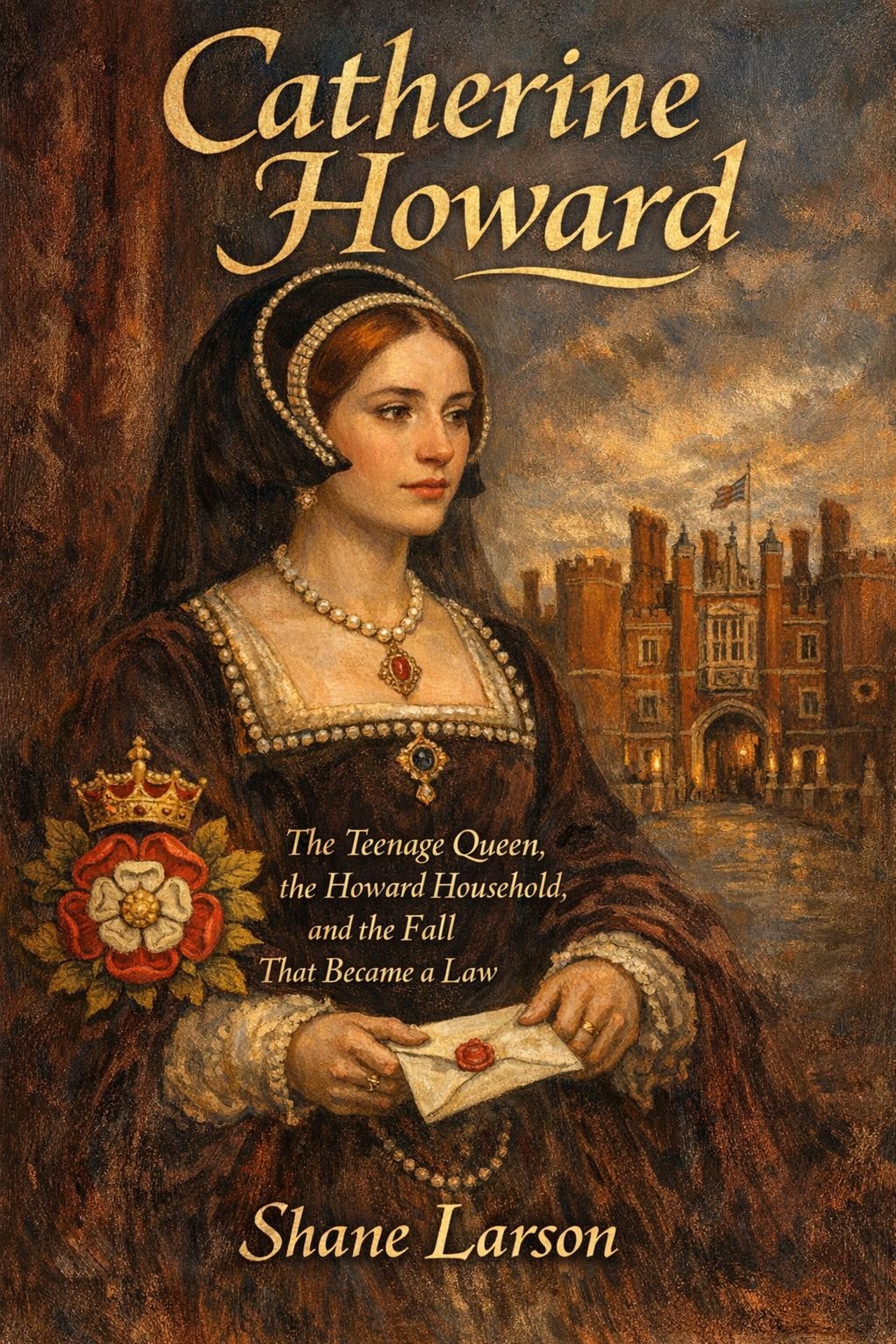
*Catherine Howard: The Teenage Queen, the Howard Household, and the Fall That Became a Law* is the fifth volume of a series on the six queens of Henry VIII. It gives the Act a chapter of its own and reads the rest of the record the way the Act deserves to be read: every detail in the depositions is attributed to the person who gave it, when, and with what at stake, and Catherine is never given a thought the sources do not record. The two questions modern historians argue over, how old she was and what was done to her at Lambeth, are set out as debates with the evidence each side needs, not settled by choosing a tone. The volume before it, *Anne of Cleves*, ends on the morning this one begins: 28 July 1540, when Cromwell died on Tower Hill and Henry married Catherine at Oatlands.
Catherine Howard
New posts and releases, straight to your inbox. No spam, unsubscribe anytime.