Did Elizabeth I Name James as Her Heir? What the Four Witnesses at Richmond Actually Say
October 29, 2026 · 8 min read
At about three in the morning of Thursday 24 March 1603, by the reckoning of a law student who was at Richmond that week and talked to one of her chaplains, Elizabeth I died. She was sixty-nine and had reigned for forty-four years. By ten or eleven that morning her Secretary, Robert Cecil, was reading a proclamation at the gate of Whitehall declaring James VI of Scotland King of England by lawful right of descent. The text had been drafted in advance and, by the usual account, sent north for the king's approval some time before.
The question that has been asked ever since is whether, somewhere between those two moments or just before them, the queen herself named him. She had refused to for forty-four years. The official story is that she gave way at the very end, and the story is told so often that it reads like a fact. It rests on four witnesses. It is worth knowing who they were.
What she had said for forty years
Elizabeth explained her refusal more than once, and the clearest statement of it is the earliest. In September 1561 the Scottish envoy William Maitland came to ask her to recognise Mary Queen of Scots as her heir, and she told him, by his own written account, that she had been the second person in the kingdom in her sister's time and knew how many had turned towards her then who should not have, and that to name a successor was to have her own winding-sheet held up before her eyes.
She was still saying it a quarter of a century later. In November 1586 both houses of Parliament petitioned her to execute the Queen of Scots, and in her second reply, on 24 November, she told them, in the version the antiquary Simonds D'Ewes copied into his journals, that if she said she meant not to grant their petition she might say more than she perhaps meant, and if she said she meant to grant it she would be telling them more than it was fit for them to know, and that they must therefore accept from her an answer answerless. That phrase is the nearest she came to a doctrine. She did not change her mind about this under pressure, and in March 1603 the pressure was the greatest it had ever been, because she was dying and everyone knew it.
Witness one: the council
The first account is the council's own, given out at the time and later made official by the historian William Camden, writing under James. In the form usually quoted, on about 22 March, while she could still speak, three councillors came to her at Richmond to ask her mind: the Lord Admiral, the Lord Keeper and Cecil. She told them that her throne had been the throne of kings and that she would have no rascal succeed her, and when they asked what she meant, that a king should follow her, and who should that be but her nearest kinsman, the King of Scots.
It is a good story and it may be true. The difficulty is who is telling it. Since the spring of 1601 Cecil had been conducting a secret correspondence with James, in cipher, through intermediaries; in the key they used the King of Scots was 30 and Cecil was 10, and the letters were printed in Edinburgh in 1766. What Cecil offered James was a method: stop pressing for recognition, write to the queen often and graciously, and trust the men who held the offices of state to see him in when the day came. It worked because nobody ever named anyone to her face. The men who gave out the account of the designation were the men who had arranged the succession behind her back, and they needed James's title to rest on something more than their own act.
Witness two: a law student's diary
The second is John Manningham, a law student whose diary entry for 24 March records the gentle death on the word of Dr Henry Parry, one of the queen's chaplains, who told him he was present: she went mildly, like a lamb, easily, like a ripe apple from the tree. His entry for 23 March, also from Parry, has her all but speechless for two days already, which sits awkwardly with a spoken exchange on the 22nd.
The exchange itself turns up in Manningham's diary only on 13 April, three weeks after she died, with no informant named: asked whom she would have to succeed her, she said no rascals would sit in her seat, and when pressed, that it would be a king, the King of Scots, who had the best right. That is early, and it agrees with the council's story, which suggests that is where it came from. Read that way, the council and the diary are one source heard twice, not two.
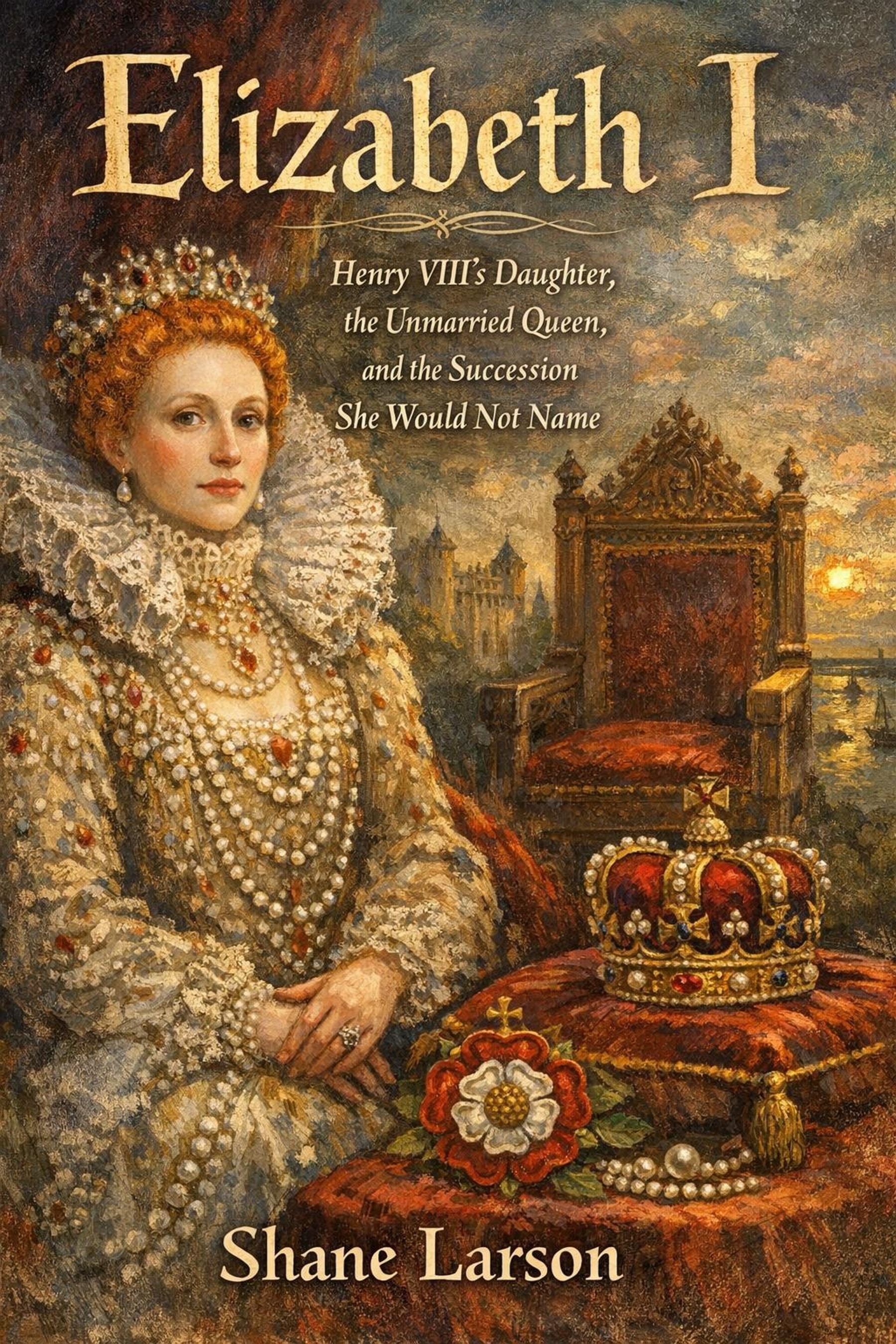
Elizabeth I
Witness three: the man who rode north
The third is Robert Carey, a younger son of the queen's cousin Lord Hunsdon, who had come down from the Scottish border and found her sitting on cushions in a withdrawing chamber, refusing her bed. His memoirs, written in the 1620s and printed in 1759, are the fullest account of her last days and the source of the detail everyone remembers. By Wednesday 23 March she could no longer speak. Carey says that in the afternoon the council came and asked her, by signs, whom she would have succeed her, and that when the King of Scots was named she put her hand to her head, and that by this they all knew he was the man. At about six that evening she made signs for the Archbishop of Canterbury, and Carey went in with him and knelt while the old man prayed at her bedside long after he wanted to rise.
Carey gives the sign, not the words. He says he was in the room at six o'clock; he does not say he was there in the afternoon, and his account of the hand reads like what the councillors told him. He also had more riding on the designation than anyone. He left Richmond between nine and ten on the morning of the 24th, before the proclamation and against the council's wishes, on horses he had posted along the Great North Road days earlier, and he was at Holyroodhouse late on Saturday 26 March, something near four hundred miles in under three days, bleeding from a kick in the head on the last stage. He beat the council's own messengers, James gave him his hand to kiss, and the ride made his fortune, as he had meant it to. Twenty years later, under the king whose title he was confirming, he wrote it all down.
Witness four: the maid of honour
The fourth witness says there was nothing to see. Elizabeth Southwell was a maid of honour among the ladies attending the queen in those weeks, and by the usual identification the Lord Admiral's granddaughter. In 1605 she went abroad with Leicester's illegitimate son Robert Dudley and became a Catholic, and in 1607 she wrote an account of the queen's death that came down through Catholic hands and is generally associated with the Jesuit Robert Persons. In it the queen, asked to name a successor, gave no answer anyone could honestly read, and the council made up its story afterwards. She adds, among other things, a playing card, the queen of hearts with a nail through its head, found fixed beneath the queen's chair.
Her Catholic readers wanted a death that carried no blessing on a Protestant succession, and a convert in exile gave them one. Her place among the queen's women is a reason to hear her. Her later company is a reason to doubt her.
What can honestly be said
Less than any of the four claims. No disinterested person recorded the queen designating James, in words or by a sign, and the earliest account of the designation is the account of the men who most needed it. Equally, nobody recorded her naming anyone else or rejecting him. If she did say what the council said she said, it would have been the first time in forty-four years she had come near to naming an heir, and the last moment at which doing so could do her no harm. That fits her policy so exactly that it may be true for that very reason.
It also mattered less than it looks. James's right did not rest on a nod. It rested on his descent from Henry VII through Margaret Tudor, the line that Henry VIII's will, made under the authority of an Act of Parliament, had expressly passed over in favour of his younger sister's descendants: Katherine Grey, and the Seymour grandsons whose story belongs with *Jane Seymour*. On 24 March 1603 the council set that will aside in favour of blood, and Parliament confirmed the choice the following year. A dying queen's gesture, real or reported, was better cover for that than a statute would have been.
Her father had married six times, passed three Acts of Succession and made a will to fix who would come after him. His daughter's settlement, at the end, was a movement of the hand that may or may not have been made, read by people who had already decided what it meant.
*Elizabeth I: Henry VIII's Daughter, the Unmarried Queen, and the Succession She Would Not Name* is the companion and epilogue to a series on the six queens of Henry VIII. It follows the refusal from the daughter of *Anne Boleyn* through the Tower, the suitors, the cousin and the warrant to the night at Richmond, and traces every famous sentence of the reign to whoever first wrote it down.
Elizabeth I
New posts and releases, straight to your inbox. No spam, unsubscribe anytime.