His Mark: What It Meant to Sign Your Name With an X in the American West
August 20, 2026 · 6 min read
Go through a county recorder's books for almost anywhere in the American West in the 1880s and you will find, scattered through the deeds and the mortgages and the bills of sale, a particular arrangement of ink.
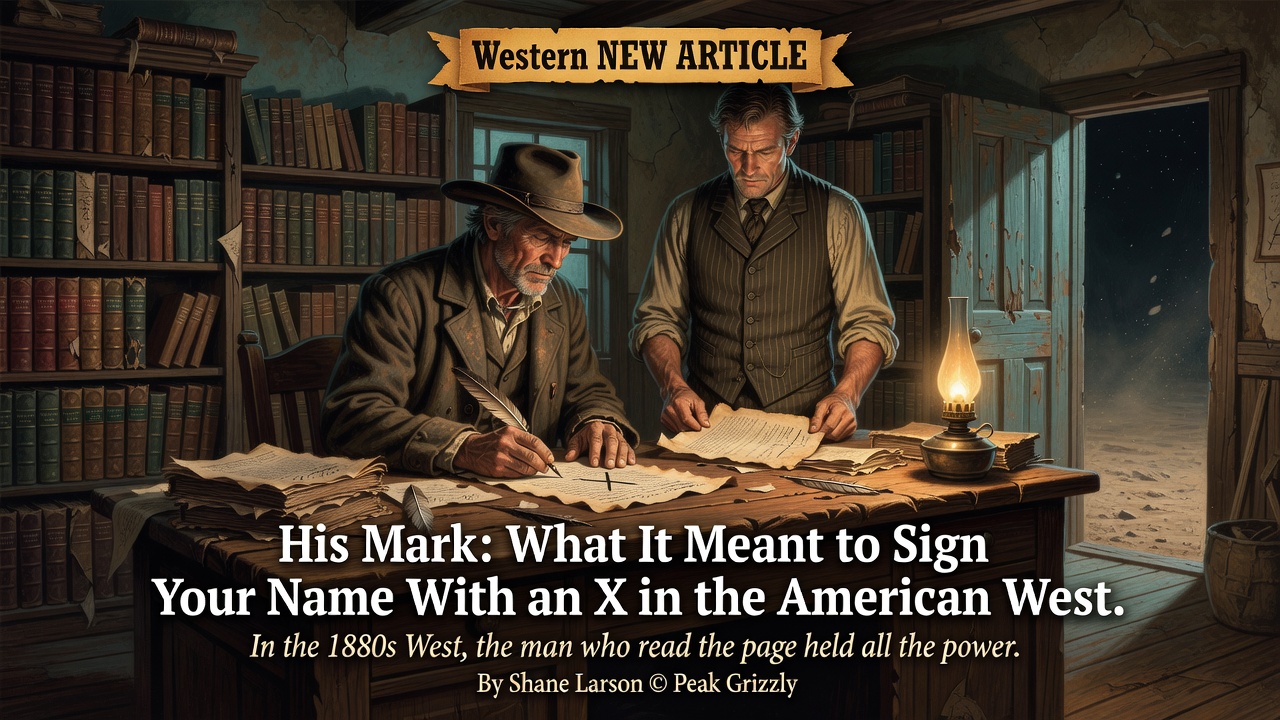
Someone has written out a name in a clerk's careful hand. Between the given name and the surname there is a gap, and in the gap somebody else has drawn an X — usually shaky, usually larger than the writing around it. Beside it, in the clerk's hand again, two words:
his mark.
That is a signature. It is legally binding, it was witnessed, and it was almost certainly made by a person who had just had the document read aloud to them and had no way at all of checking whether the reading was accurate.
How common this was
Nineteenth-century American illiteracy is one of the better-documented things about the period, because the census asked. From 1840 the enumerators recorded whether people could read and write, and by the second half of the century the question was being put to everyone over the age of ten.
The national picture in the decades either side of 1880 is roughly this: something in the range of one in five American adults could not read, and the figure was falling steadily but slowly. It was not evenly distributed. It was far higher among people who had been enslaved and were now, a generation later, entering into contracts and buying land. It was higher among recent immigrants working in mines and on railroad grades. It was higher in rural districts than in towns, and higher among men doing outdoor labour than among the clerks and shopkeepers who served them.
Which is to say: on a cattle drive, in a mining camp, in a freight yard, or in the waiting room of a stage station, the odds that some of the people in the room could not read the notice on the wall were very good indeed.
The law had a procedure for it, and the procedure was trust
The mark was not a workaround. It was a settled part of American legal practice, with its own etiquette, and the etiquette is revealing.
A person signing by mark did not simply draw an X. The document was read aloud to them. A witness — often the clerk, the notary, or whoever was handy and could write — wrote the signer's name, left the space, watched the mark made, and then subscribed their own name as witness to it. On instruments that had to be acknowledged before an officer, the officer's certificate would state that the contents had been made known to the signer.
Read that sequence again and notice where the load-bearing member is.
Everything in it depends on one thing: that the person doing the reading read the document that was actually on the table. Not a summary of it. Not the version that suited them. The paper itself, in full, out loud.
There was no mechanism to check. There could not be. The entire apparatus of witnesses, attestations and acknowledgments exists to prove that a mark was made freely by the right person — and none of it, not one clause of it, can prove that what was read aloud was what was written down.
The most powerful person in the room was the one who could read
This is the part that got hold of me and would not let go.
We tell the story of the frontier as a story about force. The fast draw, the cattle baron, the hired gun. But the transactions that actually decided who owned the West were paper transactions, and a great many of the people on the wrong end of them could not read the paper.
A homestead entry ran on paperwork: an application, an affidavit, proofs of residence and improvement, witness testimony, a final certificate, and eventually a patent signed on behalf of the President. A person could live on a quarter section for five years, break the sod, build the house, raise the children — and still be entirely dependent on a land office clerk to tell them what they had just sworn to.
A bill of sale for stock, a grazing lease, a mortgage on next year's crop, a release of a mechanic's lien, a promissory note with a confession-of-judgment clause buried in the middle: every one of these was a document that a substantial minority of the population signed on somebody else's word.
The clerk did not carry a gun and did not need one.
What happens when the reading is not honest
Most of the time it presumably was. The system ran for decades and the country got built.
But the failure mode is obvious the moment you look at it, and it is not a hypothetical: there is a long documented history in American law of instruments set aside because the contents were misrepresented to a signer who could not read them. The doctrine even has a name — a person who cannot read is entitled to rely on the reading given to them, and a contract obtained by misreading it is voidable. Courts would not have needed that rule if the situation had not kept arising.
Which tells you something about how often somebody stood in a land office or a lawyer's back room and read a page aloud with a small, useful edit in it.
And what happens when the man who cannot read is the one holding the evidence
Here is the inversion that I could not stop turning over.
If you cannot read, you cannot be shown a document and made to believe it. You cannot be frightened by a warrant you are unable to verify, or reassured by a receipt, or bought off with a contract. You are immune to the entire category of pressure that paper represents — because paper has never once been able to reach you.
And if you have never read a document, you cannot be made to repeat what it says. You cannot be threatened into testifying to its contents, or tricked into confirming a false version of them, or accused afterwards of having altered it. There is nothing in your head to get at.
A man who cannot read is uniquely vulnerable to every ordinary transaction of his life, and uniquely invulnerable to exactly one thing: being made a witness against a page he was carrying.
For most of American history that was a cruel joke and nothing more. Once in a while — in the right room, on the right day, holding the right piece of paper — it would have been the only protection anybody in the story had.
This history is the spine of my novel The Unread Confession — set in Colorado in 1882, about a stagecoach guard who has spent eleven years guarding other men's paper without ever being able to read a line of it, and who ends up carrying the one document that can hang the richest man in the state. The mark, the ledgers and the reading aloud are real. The rancher is invented, and the arrangement needed no help from me.
New posts and releases, straight to your inbox. No spam, unsubscribe anytime.