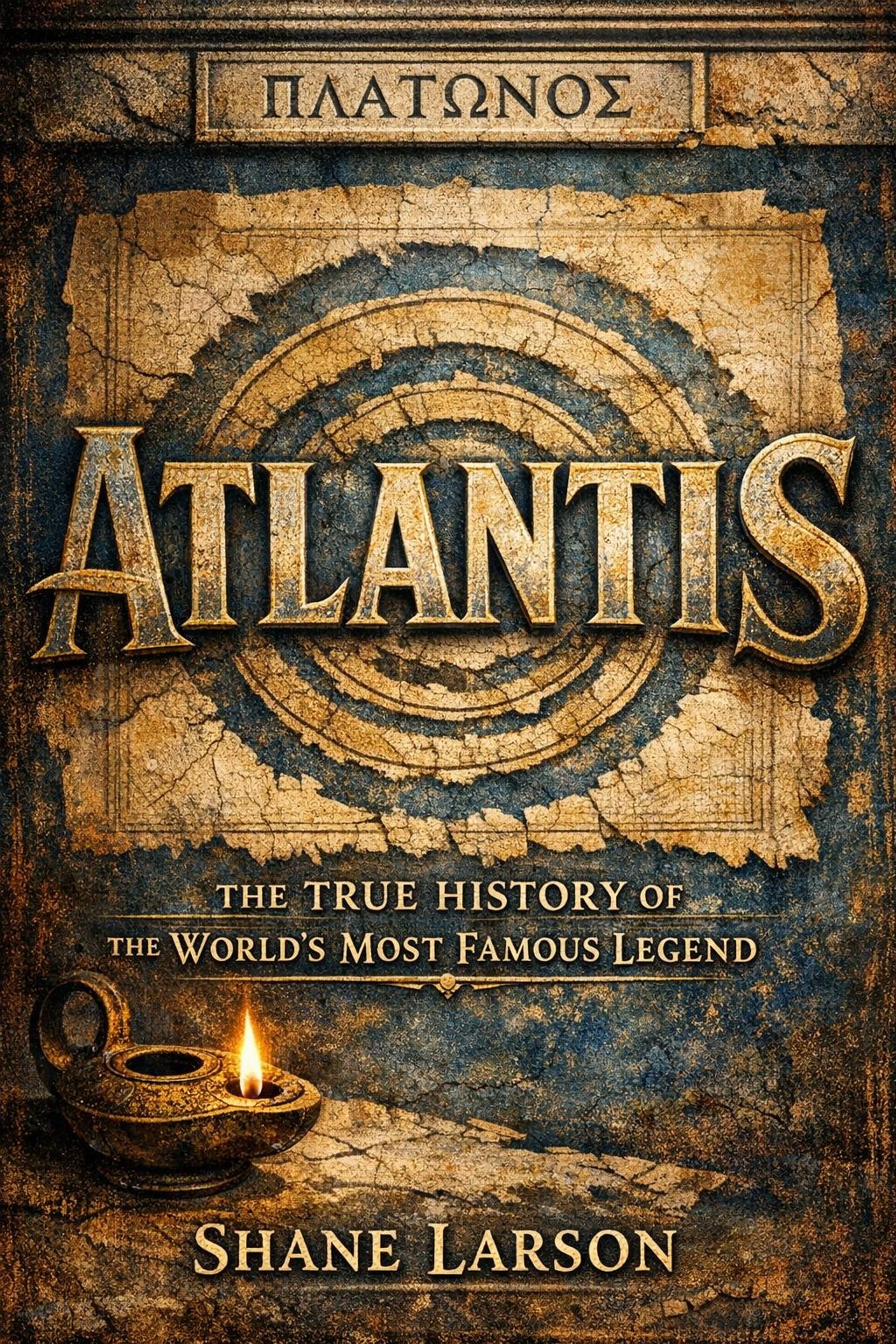
Atlantis
The True History of the World's Most Famous Legend
By Shane Larson · The Bronze Age Collapse Chronicles (Book 12)
About This Book
In September 1968, in shallow water off North Bimini in the Bahamas, divers swam over a line of flat, squared-off stones running straight along the seabed for something like half a mile. It looked like a road. It looked, to the people who wanted it to, like a wall. And it turned up in the very year a dead American psychic had been quoted as saying part of Atlantis would rise near Bimini, which made it front-page material within months.
Within a decade, geologists had cored the blocks and dated them. The stones were beachrock, a natural limestone that cracks into rectangles as it forms, and they were a few thousand years old. That should have been the end of the story. It was not, and it never is. Bimini still appears in documentaries, still draws dive tours, and still gets cited as evidence — one of several hundred places on earth that someone, at some point, has been certain was the lost island.
The useful question is not whether any of them was. It is why the search has never stopped, when every trail leads back to a single author.
A Legend With One Source
Every road to Atlantis runs through Plato. He described the island in two dialogues, the Timaeus and the Critias, in the middle of the fourth century BCE, and there is no earlier mention of it anywhere: not in Homer, not in Herodotus, not in an Egyptian archive. The provenance he gave it — an old story passed from Egyptian priests to the Athenian lawmaker Solon and down through a family — sits inside the dialogue, as part of the fiction. The second dialogue breaks off in mid-sentence, with Zeus gathering the gods to pass judgement, and Plato never went back to it.
That leaves a fascinating historical problem: a philosopher's unfinished argument outlived the civilization that produced it and became the most productive idea in alternative history. Atlantis: The True History of the World's Most Famous Legend follows that idea from Plato's desk to the streaming queue. It shows what the story was for in the first place — an imperial sea power built so that an idealised, land-bound Athens could defeat it — and the real raw material Plato had around him, including the Greek city of Helike, which the sea swallowed in his own lifetime. Then it follows the story forward through every century that found a new use for it, and closes on the places archaeology actually pulled from the water.
The tone is deliberately neither credulous nor contemptuous. The believers in this book are mostly intelligent people who were wrong in interesting ways, and they get their best case stated before the evidence is weighed.
Why I Wrote This
I came to Atlantis from the other two books in this arc. The Minoans and Thera both end in the same place, with a sunken island and a question, and I owed the reader a third book that dealt with the question honestly. It turned out that the question was more interesting than any answer to it.
What hooked me was a single dull-looking fact: there is no source but Plato. Once you hold onto that, the subject turns over completely. It stops being a treasure hunt and becomes a story about people — a philosopher arguing with his own city, a congressman who read everything, mystics, naval surveyors, television producers — each finding in the same twenty pages exactly what their moment needed. I wanted to write the version that takes all of them seriously and still tells the truth.
Frequently Asked Questions
Was Atlantis a real place?
There is no evidence that it was, and the book explains why that conclusion is firmer than it may sound. The story appears in no source before Plato, and its details do not fit any known site without discarding most of them. What is real is the material he probably drew on — Greek earthquakes and drowned towns, Egyptian antiquity, Athens' own history.
Does the book say Santorini was Atlantis?
No. It gives the Thera and Minoan Crete identification a full chapter at its strongest, because it is the best candidate anyone has proposed. Then it shows what has to be changed in Plato's account — the ocean, the date, the size — to make it fit, and concludes that the best candidate is still not a finding.
Do I need to read The Minoans and Thera first?
No. This is the third volume of a three-book arc, but it is written to stand on its own and makes no assumptions about what you have already read. If you have read the first two, you will recognise the Minoans and the eruption in Chapter 5 and again near the end.
Is this a debunking book?
Partly, but not in the usual sense. It does not mock people who have searched for Atlantis, and it spends more time explaining why the idea was persuasive in each era than scoring points against it. If you want a book that confirms Atlantis was found, this is not that book.
Does it cover the recent lost-civilization documentaries?
Yes. One chapter deals with ancient-astronaut television, the streaming documentary era and the modern lost-civilization argument. It sets out the strongest version of that case, acknowledges what its proponents get right, and then explains how archaeologists have responded.
If You Liked This, You Might Like
- The Minoans — the real island sea power that is the closest thing archaeology has to Plato's empire, and the first volume of this arc.
- Thera — the eruption at the centre of the most popular Atlantis theory, told from the geology and the empty town rather than from the legend.
- Doggerland — a genuine lost country under the North Sea, and a case study in how to tell a drowned-land story without inventing anything.
- The Collapse Pattern — the unglamorous, multi-causal way real civilizations end, which is the story Atlantis lets us avoid.
Plato built an island to lose an argument, left the last sentence unfinished, and the rest of us have been completing it for twenty-four centuries. This is the history of that completion, and of the real drowned places that were waiting underneath it.
Volume 3 of the Minoan arc in The Bronze Age Collapse Chronicles.
What You'll Learn
- **Plato's own words, read in order.** Most people who argue about Atlantis have never read the twenty pages it comes from. The book walks through them, and an appendix sets out the key passages in the public-domain Jowett translation.
- **The politics behind the island.** Plato wrote as an old man in a city that had lost its own maritime empire. Atlantis reads very differently once you see it as a mirror held up to Athens.
- **Helike, the real drowned city.** Destroyed by earthquake and wave in 373 BCE, visible under the water for centuries, and finally located under farmland in 2001. It may be the best clue to where Plato got his picture.
- **Thera, given its strongest run.** The Minoan theory is the best on the board, and the book shows exactly which of Plato's details it must throw away to fit.
- **The method behind every claim.** Keep the features that fit your site, discard the ones that do not, call what remains a match. Once you see the move, you can spot it in any documentary.
- **The one theory evidence actually killed.** Plate tectonics and seafloor mapping in the 1960s ended the idea of a sunken Atlantic continent for good.
- **How a Minnesota politician built the modern legend.** Ignatius Donnelly's 1882 bestseller is the ancestor of almost every Atlantis claim made since, and few of its descendants know it.
- **The legend's darker detours**, from Theosophy's spiritual prehistory to its misuse by twentieth-century racial ideologues, traced from the documented historiography with the popular exaggerations corrected.
- **The places that were really lost.** Pavlopetri, Doggerland, Atlit Yam and Akrotiri: drowned and buried sites that turned out stranger than the legend.
New Ancient History releases and free chapters — no spam, unsubscribe anytime.
More in The Bronze Age Collapse Chronicles
View series →

More in This Genre
View all →