The Hundred Years' War Had About Thirty Hours of Battle
September 30, 2026 · 6 min read
Add up the fighting at Crécy, Poitiers, and Agincourt — the three battles everyone has heard of, the ones with the longbows and the doomed French cavalry and the Shakespeare speech — and you get something like thirty hours. Perhaps a few more if you count generously. The war those battles belong to ran from 1337 to 1453: a hundred and sixteen years, five generations, ten kings. The famous part of the most famous war of the Middle Ages amounts to about a day and a half.
So what was happening the rest of the time?
The honest answer is the reason the war deserves to be understood rather than just remembered. For most of those years, English armies were not seeking battle at all. They were riding in a wide destructive arc through the French countryside, burning it. The tactic had a name — the chevauchée, the "ride" — and it was not an unfortunate byproduct of the war. It was the war. A mounted column would move fast through a region, torching villages, granaries, and mills, driving off livestock, and pointedly sparing nothing that paid taxes to the French crown. The point was partly economic: a burned district could not fund the enemy. But it was mostly political, and the logic was brutally clean. A medieval king's legitimacy rested on his ability to protect his subjects. Every column of smoke on the horizon was an argument that the king of France could not do the one thing a king was for.
The battles happened, for the most part, when one of these raids went wrong — when a French army finally cornered a raiding column that would rather have kept moving. Crécy in 1346 and Poitiers in 1356 were both fought by English armies trying to get away. So, essentially, was Agincourt in 1415, fought by a sick and starving army marching for the coast. The great English victories of the war were the failures of English strategy, redeemed at the last moment by the longbow, the terrain, and French command decisions that read, even six centuries later, like a manual of how not to run a battle.
The war that ate a pandemic
Eleven years into the war, the Black Death arrived. This is the fact that most retellings handle worst, because the plague is usually written as its own self-contained catastrophe — a horseman galloping through a separate chapter. It wasn't separate. It landed in the middle of the largest war in Europe, killed something like a third of both kingdoms, and the war did not stop. There was a pause of a few campaigning seasons, and then the armies were out again, recruiting from a labour pool the disease had cut nearly in half.
What the plague did do was rewire the economics underneath the fighting. With workers suddenly scarce, wages doubled. Both governments responded with laws — England's Statute of Labourers, matching French ordinances — that tried to freeze wages at pre-plague levels, which meant both governments spent the second half of the fourteenth century simultaneously taxing their peasants to pay for the war and legislating to keep those same peasants poor. The result was arithmetic, and the arithmetic produced revolts: the Jacquerie north of Paris in 1358, England's great rising of 1381. Same mechanism, twenty-three years apart, triggered in England by a poll tax levied to fund a war that was by then visibly going nowhere.
The Hundred Years' War
What a century of soldiers' wages actually built
Here is the argument that makes the war more than a costume drama. Wars have to be paid for, and a war that runs a hundred and sixteen years has to be paid for in ways that outlast any king. In England, the crown could not levy general taxes without consent, so consent had to be asked for — over and over, war grant after war grant, for more than a century. The institution that granted or withheld the money met so often, and bargained so hard, that it hardened from an occasional assembly into a permanent feature of the state. A striking share of Parliament's early muscle was built lifting war taxes.
France solved the same problem the opposite way. After the catastrophes of the 1350s — a king captured at Poitiers and ransomed for more gold than the kingdom could produce — the French crown won the right to tax without asking. The taille, born as an emergency war levy, simply never went away, and by the war's end it was funding something no medieval kingdom had ever maintained: a permanent, professional, standing army, including the artillery train that finished the war in a five-year avalanche of falling English fortresses. England's war built a parliament that could say no to the king. France's war built a king who never had to ask. You can draw a line from those two settlements through the next four centuries of both countries' history, and historians have.
Neither outcome was anyone's plan. England began the war with its kings holding a rich slice of France and its aristocracy speaking French; it ended with nothing left but Calais, English replacing French in law and government, and a national identity substantially built out of a hundred years of fighting the neighbours. France began the war as a loose federation of magnates and ended it as the most centralized state in Europe. Two feudal kingdoms walked into a lawyers' quarrel about an inheritance, and two recognisable nation-states walked out.
The transcript
One more thing filled the years that the battles didn't, and it deserves its own mention: in 1431, in English-held Rouen, a nineteen-year-old peasant girl was tried by a church court for heresy, and the complete transcript survives. Joan of Arc is the war's most famous name, and the record of her interrogation is one of the most extraordinary documents of the entire Middle Ages — a barely literate teenager, questioned for weeks by trained theologians laying deliberate traps, holding her own so effectively that her answers were being retold with admiration within a generation. Twenty-five years later the same church reopened the case and reversed the verdict, which means we have two full official records of the same events, compiled by the same institution, reaching opposite conclusions. Read against each other, they are as close to a documentary about the fifteenth century as we will ever get.
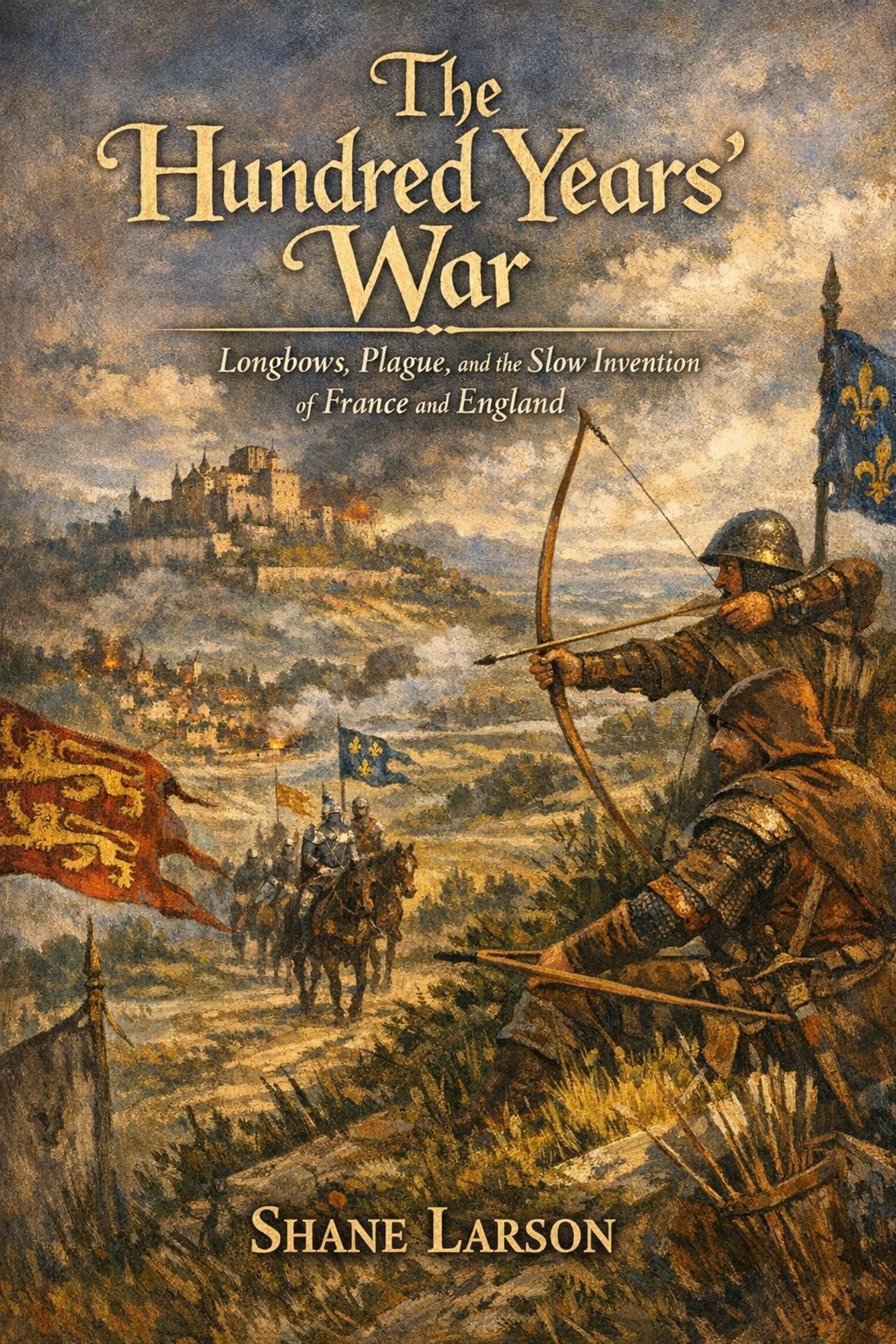
The whole story — the raids, the plague, the money, the girl, and the guns that ended it — is the subject of my book *The Hundred Years' War: Longbows, Plague, and the Slow Invention of France and England*. It covers the entire span in a single volume: how a homage ceremony in Amiens curdled into the longest war in European history, what the longbow actually did and when it stopped mattering, and how the bill for a hundred and sixteen years of soldiers came due as the two nations that are still there. If you have ever wondered what happened in the hundred and sixteen years around the thirty famous hours, this is that book.
The Hundred Years' War
New posts and releases, straight to your inbox. No spam, unsubscribe anytime.