I Wrote Down Everything My History Teacher Said in 1990. Thirty-Five Years Later, I Turned It Into a Book.
August 13, 2026 · 6 min read
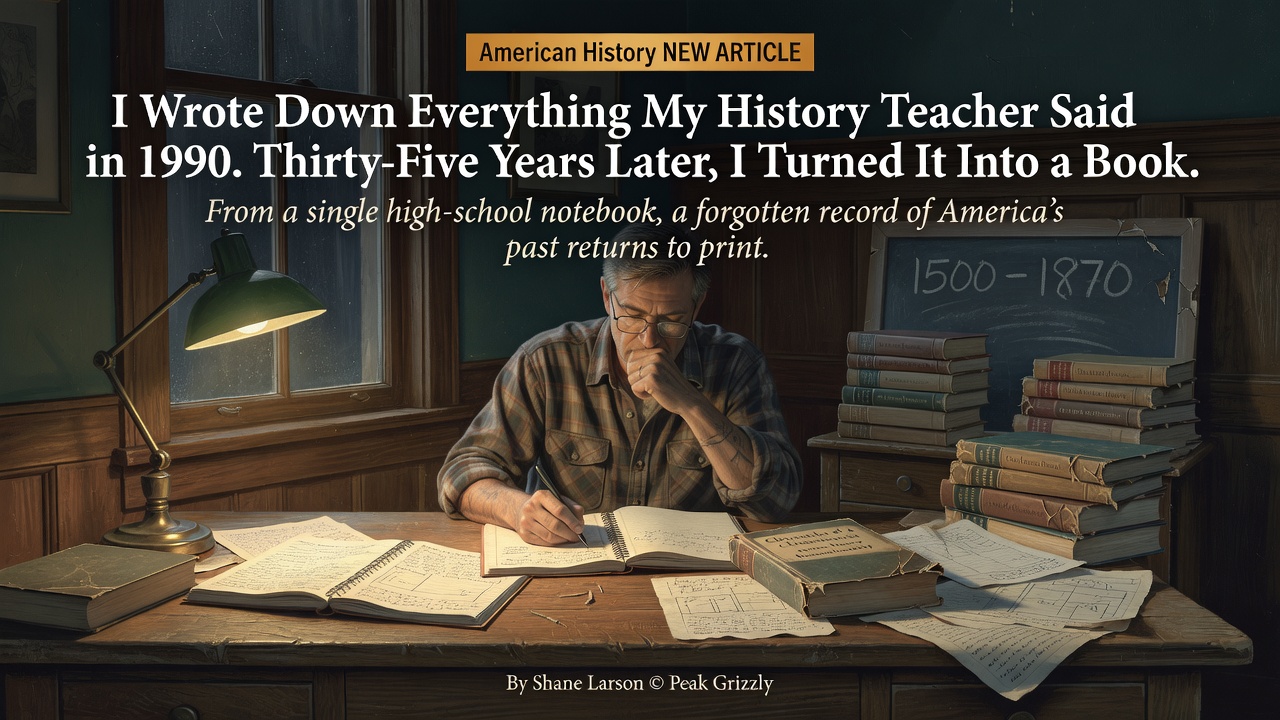
On September 4, 1990, in the first meeting of a two-semester Advanced Placement American history course, my professor wrote a date range on the board: 1500–1870. I copied it into a fresh spiral notebook, along with the names of the assigned textbooks and a fragment that reads, cryptically, "History of Two nations." I was sixteen.
The course did not stop at 1870. It did not stop at 1945, or 1963, or Watergate. The last dated entry in that notebook is June 20, 1991 — notes on the Carter presidency and Reagan's "Teflon shield." The professor taught American history right up to the edge of the present he was standing in. And then the notebook went into a box, where it followed me from house to house for thirty-five years.
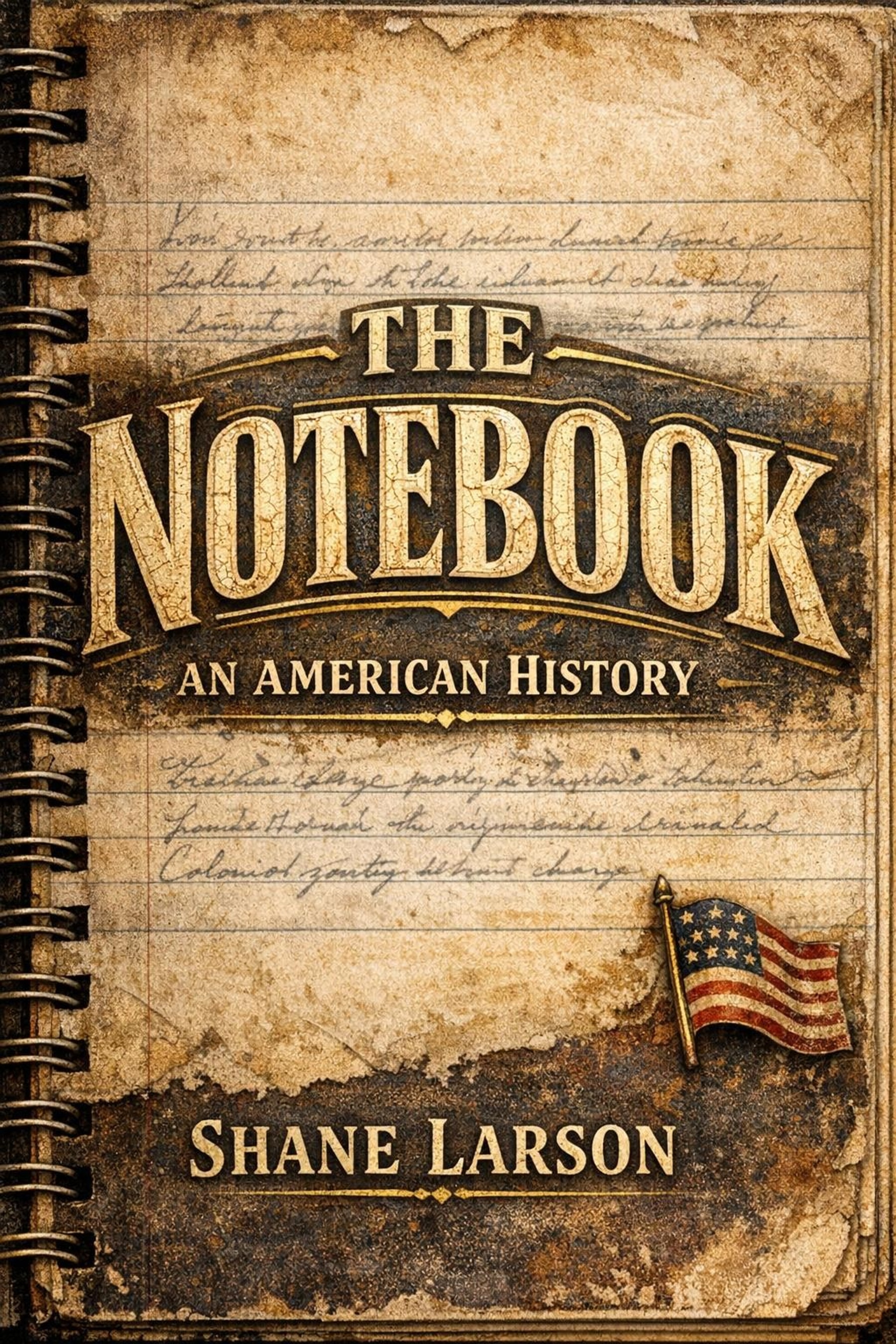
I've just finished turning it into a book. Not a memoir about the notebook — the actual history in it, all 171 handwritten pages, rebuilt into a complete narrative of the United States. I remember almost nothing of that classroom beyond what the pages hold. That turned out to be the point. Along the way I learned something I didn't expect: a survey course is itself a primary source. What a nation teaches its sixteen-year-olds is as much a historical artifact as anything it did.
The professor was making an argument, not listing facts
The caricature of a history survey is a forced march through dates. This classroom wasn't that. Read in sequence, the notes reveal a professor with a genuine interpretive spine, sustained across an entire academic year.
His opening move: colonial America didn't shed England's class system — it imported the whole apparatus. The first lecture is a diagram of the English social ladder, numbers attached: an aristocracy of about two hundred families, a gentry of about 16,400, and beneath them the cottagers and the poor. (Those numbers, it turns out, come straight from Gregory King's famous 1688 social table — the professor had done his reading.) The colonists who mattered, he argued, were lower gentry and aspirants, and the whole colonial project — Winthrop's Massachusetts, Byrd's Virginia — was gentry re-formation under frontier conditions. The Puritans, he told the class flatly, "were not out to create a democracy. They created a gentry."
His biggest idea came mid-fall, and it structures the book I've built: America never established a national church — the founders deliberately declined to — but it built a functional substitute he called the Religion of the Republic. Fundamental law as scripture. The Declaration, the Constitution, and eventually the Gettysburg Address as a civic bible. McGuffey's Readers as catechism. Democracy itself elevated, in his phrase, "to a level of religion." If you've read Robert Bellah on American civil religion you'll recognize the family resemblance, but the professor taught it with a specificity all his own — down to a nine-point doctrinal core of nineteenth-century evangelicalism and a precise accounting of who it excluded.
And then there's the emphasis nobody would predict: the notebook gives the Baby Boom more classroom hours than the Constitutional Convention. Nearly three straight weeks of lectures — demographics, rock and roll's five regional styles, divorce rates, the housing squeeze, "nostalgia is the arthritis of the baby boomers." In 1991 the oldest Boomers were turning 45, and here was a professor teaching their midlife as history while they were living it. I kept that proportion in the book, because the obsession is itself a historical fact.
Teaching the Cold War six months before it ended
Here's the part that still gets me.
The Notebook
My notes from the spring semester include a unit on the Cold War — Truman Doctrine, Marshall Plan, Berlin Airlift, the whole architecture. At the end of one lecture on the arms race, I wrote down the professor's summation: "Neither side wanted to lose. Eventually Russia would give up."
Eventually Russia would give up. Written in a teenager's notebook in the spring of 1991. The Soviet Union dissolved that December — six months after the course's final lecture. The professor was making a prediction, and it was already coming true as he spoke, and he had no way to know.
The notebook is full of these moments — the present tense of 1991 fossilizing into history mid-sentence. The professor compares the Panic of 1873 to "the S&L crisis," Teapot Dome to Watergate, Grant's cabinet to "more recent administration[s]." After the Persian Gulf War, which ended mid-semester, he tells the class: "we looked good, so we will be good for a while." He predicts the Boomers "will face a grim future in old age," that Vietnam "will slow down adventurous ideas for a long time," that by 2000 the median voter will be 42. Some of those aged well. Some didn't. The book grades them all from the present, in an appendix — because watching a smart person reason about a future you've already lived is one of the strangest reading experiences there is.
What do you do when your primary source is wrong?
A student's notebook is not a signed treaty — even when the student was you. It's what one sixteen-year-old heard, understood, and had time to write down, filtered through a professor's own errors and thirty-five years of fading ink.
My notebook says D-Day was July 6. It says Hitler died April 21. It dates Paul Ehrlich's The Population Bomb to 1978 — off by a decade. It repeats the false story about how Mama Cass died. It claims Herbert Spencer helped Darwin develop evolution (the influence ran the other way). Three physical pages are missing entirely.
The temptation, building a book from material like this, is to silently fix everything and present a seamless surface. We did the opposite. Every correction happens in the text, matter-of-factly — and then every one of them is logged in a dedicated appendix called "What the Notes Got Wrong," alongside the professor's opinions that were delivered with the flat authority of fact ("the smartest president since Jefferson is Jimmy Carter" — an actual classroom moment, October 1990). A second appendix, a concordance, maps every chapter of the book back to the specific notebook pages and lecture dates it was built from. The missing pages are marked missing. Nothing is invented to fill them.
That discipline turned out to be the book's whole character. History with the seams showing beats history with the seams hidden, because the seams are where the trust comes from.
The last page
The notebook's final entry, June 20, 1991, is a hurried sketch of the 1976 and 1984 elections — Ford "a nice man in an impossible situation," Carter the outsider, Reagan with his "Teflon shield." And then it just stops. No summation, no final exam notes, no farewell. A year of American history, told right up to the edge of what the teller could know, ending mid-thought the way the present always does.
If any of this resonates — the argument, the time capsule, the seams — the book goes much deeper: twenty chapters, from the gentry ladders of 1600s England to that last June lecture, with the full concordance and corrections apparatus in the back.
The Notebook: An American History is available now on Amazon Kindle and in paperback.
The Notebook
New posts and releases, straight to your inbox. No spam, unsubscribe anytime.