Nobody Really Called It Seward's Folly: What the Newspapers of 1867 Actually Said About Buying Alaska
October 8, 2026 · 8 min read
Ask anyone what they know about the Alaska Purchase and you will get the same two words back. Seward's Folly. The Secretary of State bought a frozen wasteland for seven million dollars, the country laughed at him, and then gold turned up and the country stopped laughing. It is one of the few episodes of American diplomatic history that nearly everyone can tell from memory, and it is told the same way every time, because it has a shape that people like. The lone visionary. The jeering crowd. The vindication.
Seward's Day is a state holiday where I live, and the version of the story that gets told on it is the one above. I spent a book finding out how much of it is true. The answer is: the jokes were real, and almost everything built on top of them is not.
Ten days and thirty-seven votes
Start with what the record shows, because the record is unusually clear.
The treaty was signed at about four in the morning on 30 March 1867, in the State Department's temporary quarters on Fourteenth Street, after a night session that Seward called on the spot when the Russian minister, Eduard de Stoeckl, brought word that the Tsar had accepted the terms. President Johnson's message transmitting it went to the Senate the same day. The Senate took it up in special session, heard Charles Sumner speak for three hours on 8 April, and ratified it the next day by thirty-seven votes to two.
Ten days from signature to ratification is quick for any treaty. For a treaty that added something like a fifth to the land area of the country, it is remarkable. A Senate that thought it was being asked to buy an icebox would not have moved at that speed, and two senators out of thirty-nine is not a jeering crowd. It is a rounding error.
The press is where the folly story is supposed to live, and the press is where it falls apart. In 1958 a historian named Richard Welch did something nobody had bothered to do in ninety years: he went back and read the newspapers of 1867 systematically, instead of repeating the same handful of quotations that had been passed from one book to the next. He found that the clear majority of American papers supported the purchase, a good number of them with real enthusiasm. The West Coast press wanted the fisheries and the fur trade. The commercial papers liked the Pacific. Plenty of editors simply thought that a continent-sized territory for seven million dollars was obviously a good buy, which is what most people have thought ever since.
The ridicule existed. "Walrussia," "Icebergia," "Seward's icebox" and "Johnson's polar bear garden" all appeared in print in the spring of 1867, and they are genuinely funny, which is one reason they survived. But they came from a quarter that is easy to identify. Horace Greeley's New York Tribune worked the vein hardest, and the Tribune in 1867 was the voice of the Radical Republicans who were at war with Andrew Johnson's administration and would have mocked Seward for buying the Garden of Eden if Johnson had signed the deed. A few other papers argued that the money was better spent at home, two years after a war that had cost the Treasury several billion dollars. That was a reasonable position and some serious people held it. It was not the national mood.
And the phrase itself, the two words everyone knows? "Seward's Folly" was not the common label of 1867. It grew later. It grew through the Klondike years at the end of the century, when the purchase could be presented as a bet that had paid off, and it grew through a hundred years of school textbooks that liked a story with a vindicated visionary at the end of it. The folly is, to a large degree, a retrospective invention, and it flatters the people who repeat it. We would not have laughed. We know how it turned out.
Where the honest version gets complicated
It would be easy to stop there and declare the myth busted, and some popular accounts do. I think that is a mistake, and so do the historians who have looked hardest at the question.
Opposition to the purchase was real. It was loud in places, and it showed its teeth not in the Senate but in the House of Representatives, which did not get to vote on the treaty but did have to vote the money. The House declined to do so for more than a year. Part of the reason was that it was occupied with trying to remove the President; the impeachment of Andrew Johnson ran through the spring of 1868 and the Alaska appropriation was collateral damage. But part of it was a genuine bloc of congressmen who thought the deal was bad, or thought the Senate had been bounced into it, or resented being handed a bill for a treaty they had never been consulted on. The appropriation finally passed in July 1868, by 113 votes to 43, and forty-three is a bigger number than two.
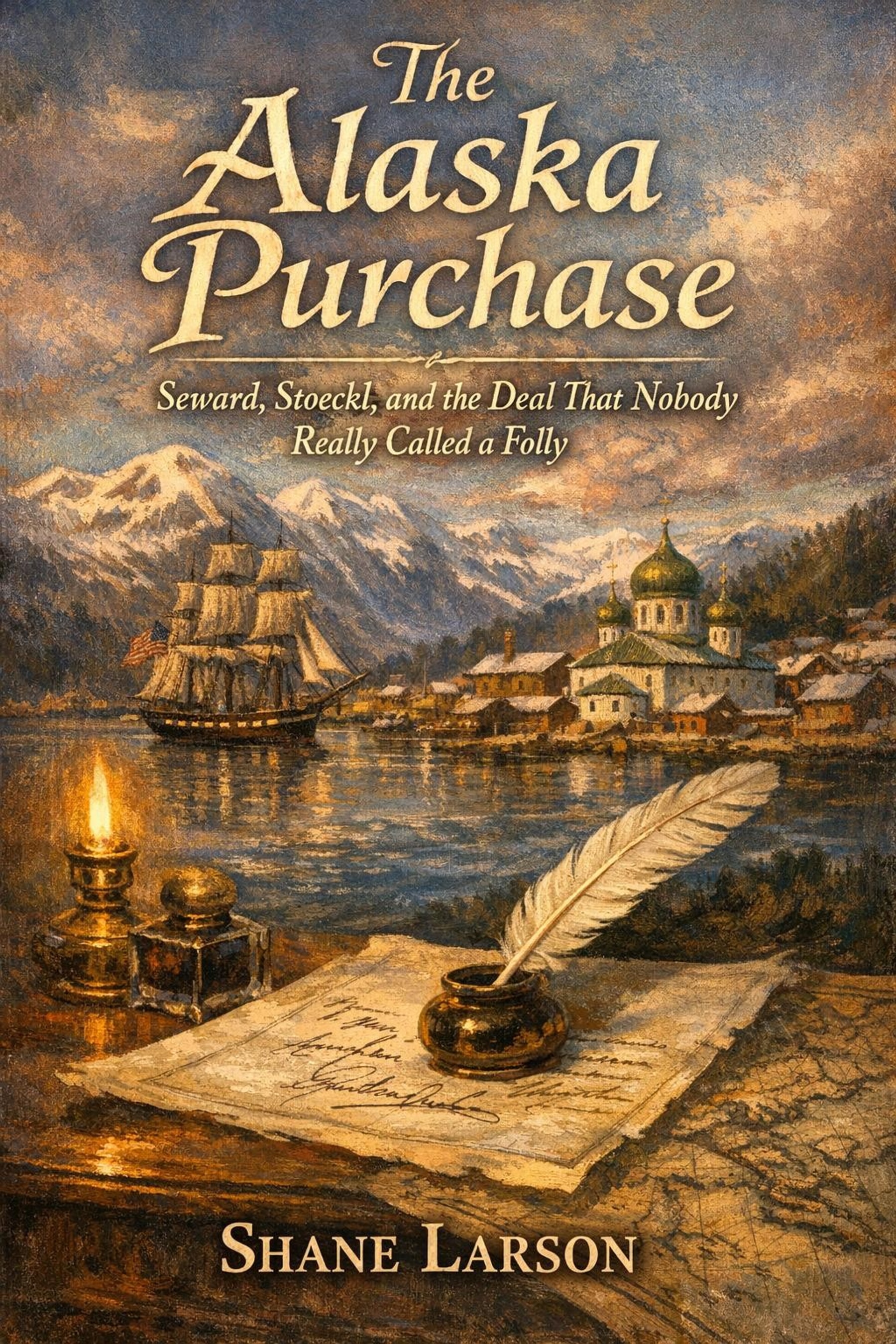
The Alaska Purchase
Then there is the matter of how it passed. Stoeckl received the $7.2 million and sent noticeably less than that to St. Petersburg. Where the rest went was investigated by a House committee in 1868 and 1869, with allegations that money had reached a former Treasury Secretary turned lobbyist, a prominent newspaper publisher, and possibly members of Congress. The committee proved nothing. Nobody has proved anything since, and nobody has disproved it either. A treaty that needed a lobbying budget to get its money through the House was not sailing on a tide of universal approval.
Lee Farrow, whose 2016 study is the best short modern account, makes the point directly: the revisionist story can be told too tidily. "The press supported it" is true as a majority statement and misleading as a summary, because the minority that did not was articulate, well placed, and in some cases right about the specifics. The honest version has three parts. The purchase was popular with most of the people who had an opinion. A vocal minority ridiculed it, and a larger, quieter minority had practical doubts. And the ridicule has since been inflated in the retelling until it swallowed the rest.
That is a less satisfying story than either "everyone laughed" or "nobody laughed." It is also the one the documents support, and the book sets out the evidence on both sides rather than picking the side that makes a better anecdote.
The folly that actually happened
Here is the thing the "Seward's Folly" story is most useful for hiding, and it is the reason I think the myth is worth taking apart rather than just correcting.
If the purchase was not the folly, something was. The United States paid its two cents an acre, raised the flag over Sitka on 18 October 1867, and then declined for seventeen years to give the place a government.
There were no courts. There was no land law, which meant that nobody in Alaska could legally own a house, a mine or a fish camp, record a deed, or make a valid will. For a decade the Army ran the territory as a military department, from a handful of garrisons whose principal documented activity was the drinking and smuggling of liquor. In 1869 a Navy gunboat destroyed the Tlingit villages at Kake on the Army's request. In 1877 the Army left to fight the Nez Perce and did not come back, and the senior federal official in a territory twice the size of Texas became a customs collector. In 1879 the residents of Sitka, afraid of an attack that may or may not have been coming, appealed for protection to a British warship, because there was no American one to ask. The Navy took over, and in October 1882 it shelled and burned the village of Angoon over a dispute about compensation for a Tlingit man killed in a whaling-company accident. Civil government arrived with the Organic Act of May 1884, and even that brought a governor and a judge but no legislature and no way to take title to land.
And the people who already lived there were never asked. The treaty's third article sorted the inhabitants into those who could become citizens and the "uncivilized native tribes," who would be subject to whatever laws Congress chose to make. At Sitka, Tlingit leaders made the argument, recorded imperfectly by the Americans who heard it, that Russia could not sell what it had never owned. That argument took a century to win. The Court of Claims found in their favour in 1959, and the Alaska Native Claims Settlement Act of 1971 finally settled the claims of all of Alaska's Native peoples, on terms that are still argued over.
So the story told on Seward's Day gets its folly in the wrong place. The buying was quick, cheap, and broadly approved. The owning was negligent for a generation, and the negligence fell hardest on the people who had been there all along. A myth that keeps the nation's attention on 1867, on the jokes and the vindication, is a myth that never has to look at 1869, or 1879, or 1882. That is what it is for, whether or not anyone intends it.
The jokes were good. Walrussia is still funny. But the folly was never the purchase, and the people who said so at the time were not the ones who were laughing.
The Alaska Purchase: Seward, Stoeckl, and the Deal That Nobody Really Called a Folly follows the sale from the Crimean War to the Organic Act of 1884, from both capitals, with the Native argument given its own chapter and the bribery affair laid out as a case. Available now as an ebook, with the paperback to follow.
The Alaska Purchase
New posts and releases, straight to your inbox. No spam, unsubscribe anytime.