What Does Magna Carta Actually Say? Fish Weirs, Widows, Debts, and the Three Clauses Still in Force
November 11, 2026 · 8 min read
Ask anyone what Magna Carta says and you will get one sentence back: no free man shall be imprisoned except by the lawful judgement of his peers or the law of the land. That sentence is in it. It is one clause out of about sixty-three, it was not numbered, it was not emphasised, and the clause before it is about the sale of justice and the clause after it is about merchants' safe conduct. Almost nobody who can recite the famous sentence has read the other sixty-two, and the other sixty-two are where the document actually lives.
The text King John sealed at Runnymede in June 1215 is about 3,500 words of abbreviated Latin on a single sheet of sheepskin. It has no clause numbers; the sixty-three are an editorial convention imposed centuries later. It has no title; the name Magna Carta arrived in 1217, when a shorter Charter of the Forest was issued beside it and clerks needed to tell the big charter from the small one. And it is not a constitution. It is the text of a peace treaty between a king and a group of barons who had renounced their allegiance and seized London, and it reads like one: a list of specific grievances, most of them about money, answered one by one. Here is what is in it.
It starts with the church and goes straight to the price of inheriting
The first clause confirms the freedom of the English church, which John had already conceded the year before. The second gets to the point. When a tenant-in-chief died, his heir had to pay the king a relief before he could enter his father's lands, and under John the relief was whatever the king chose to ask. Nicholas de Stuteville was charged 10,000 marks in 1205. John de Lacy was charged 7,000 to inherit Pontefract. The charter fixed the relief at the old rate: £100 for an earl's or baron's whole holding, 100 shillings for a knight's fee. It was the first thing the barons wrote after the church, and it is the clearest statement in the document of what the rebellion was about.
The clauses that follow deal with wardship. If the heir was under age, the king took the estate until the boy came of age and sold the right to marry him to whoever would pay. The charter did not abolish this. It said the guardian could take only reasonable profits and must not strip the estate, and that heirs were to be married without disparagement, to partners of suitable rank.
Widows, forty days, and two hundred chickens
Clauses 7 and 8 are about widows, and they answer a trade the fine rolls record in detail. A widow with dower lands was an asset, and her remarriage was in the king's gift; under John she paid to be left alone, a hundred marks, two hundred, five hundred, from women buying the right not to be given to a stranger. The most famous entry on the rolls of the reign belongs here: in 1204 the wife of the chief forester, Hugh de Neville, offered the king two hundred chickens for leave to spend one night with her husband. Historians have read it three ways and the roll does not say which.
The charter said a widow was to have her marriage portion and her inheritance at once and without difficulty, was to pay nothing for her dower, could stay in her husband's house for forty days while her dower was assigned, and was not to be compelled to remarry so long as she wished to live without a husband. It was a provision for women of the landed class, written by their fathers, brothers and sons, and its purpose was to protect the land that came with them as much as the women. It was real protection even so, more than the law had given before, and it was never withdrawn.
Debts, and the two clauses that were cut
Clauses 9 to 11 are about debt. The king was not to seize a man's land for a debt while his movable goods could cover it, and sureties were not to be distrained while the debtor could pay. Then come two clauses about debts to Jewish moneylenders, and they only make sense once you know the mechanism. Jewish lenders were the king's property in law; their bonds passed to the crown at their deaths, and the king could call in their loans when he taxed them. Either way, a baron's debt to a lender in Lincoln or York could become a debt to the Exchequer, which had the power to take his land. Clause 10 said that if a man died owing money to the Jews the debt was to bear no interest while his heir was under age, and that if it fell into the king's hands the king would take only the principal. Clause 11 said the widow's dower came first, then the children's upkeep, then the debt. Both clauses were dropped in 1216 and never restored.
Carts, corn, fish weirs and one width of cloth
The middle of the document restrains the king's officers on the ground, and it is where the detail is thickest. No constable was to take a man's corn without paying on the spot. No sheriff was to take a free man's horses or carts without his consent, and no royal officer another man's timber for castle-building. Amercements, the fines imposed by the courts, were to be proportioned to the offence and never to the ruin of a man's livelihood: a freeholder was to keep his land, a merchant his stock, a villein his tools.
Runnymede
And in the middle of this run sits clause 33: all fish weirs were to be removed from the Thames and the Medway and throughout England, except on the coast. The weirs obstructed the boats on which London's trade depended, and London had opened its gates to the rebels in May. Two clauses later comes a demand for one measure for wine, ale and corn throughout the realm, and one width for dyed cloth. These clauses are not about liberty. They are about trade and the men who wanted it regular, and they sit in the same document, in the same hand, as the clause the whole world knows. The weir clause stayed on the statute book for centuries.
The clause everyone knows, and the one that made the peace fail
Clause 39 promised that no free man would be seized, imprisoned, dispossessed, outlawed or exiled, or ruined in any way, except by the lawful judgement of his peers or by the law of the land. Clause 40 promised that right and justice would be sold, denied and delayed to no one. Read in 1215, both are narrower than they sound. A free man was a man who was not a villein, and villeins were most of the population. Judgement by peers meant barons being judged by barons rather than by the king's officials, not trial by jury, which barely existed in criminal cases. The law of the land meant the existing customs of the realm. The clause was a promise that the king would stop doing what he had done to the Braose family, who went into his custody and did not come out, and that was the sense in which the barons wrote it.
Clause 61 is the one almost nobody has heard of. The barons were to choose twenty-five of their number to guard the peace. If the king broke any term of the charter, four of them were to complain to him; if he had not put it right within forty days, all twenty-five, with the commune of the whole land, were to distrain him by seizing his castles, lands and goods until he did, sparing only his person, his queen and his children. It is a licence for rebellion written into a peace settlement. No king could live with it, John did not try, and the pope, who was by then his feudal overlord, annulled the whole charter on 24 August 1215, ten weeks after it was sealed.
What survived
The charter survived because John died in October 1216 and the regents for his nine-year-old son needed something to offer the rebels. They reissued it at Bristol in November with the dangerous parts cut: clause 61, the clauses requiring the common counsel of the realm before any scutage or aid, the two Jewish debt clauses, the expulsion of named foreign captains, and most of the terms for Wales and Scotland. They reissued it again in 1217, and in 1225 the young king granted it a third time in return for a tax, a fifteenth on movable goods. The 1225 text has thirty-seven chapters, and it merges clauses 39 and 40 as chapter 29. In 1297 Edward I had it entered on the statute roll, and that is the text from which English law still counts.
Then the repeals began, in the late 1820s, and went on for a century and a half as one chapter after another was found obsolete, until the Statute Law (Repeals) Act of 1969 swept away nearly everything that was left. The Charter of the Forest lost its last provisions in 1971. Of the 1297 text, three chapters remain in force in England and Wales today: chapter 1, the freedom of the English church; chapter 9, the ancient liberties of the city of London and the other cities, boroughs and ports; and chapter 29, the promise about free men and the law of the land. Everything else that John sealed has gone.
So the honest answer to the question is this. Magna Carta is a map of the grievances of the English baronial class in the year 1215, with the king's officers, the price of inheriting, the remarriage of widows, the Thames fishery and the width of a bolt of cloth all marked on it, and one clause in the middle that later centuries found they could build on. The map is the document. The building came later, and it is a different story, and both are history.
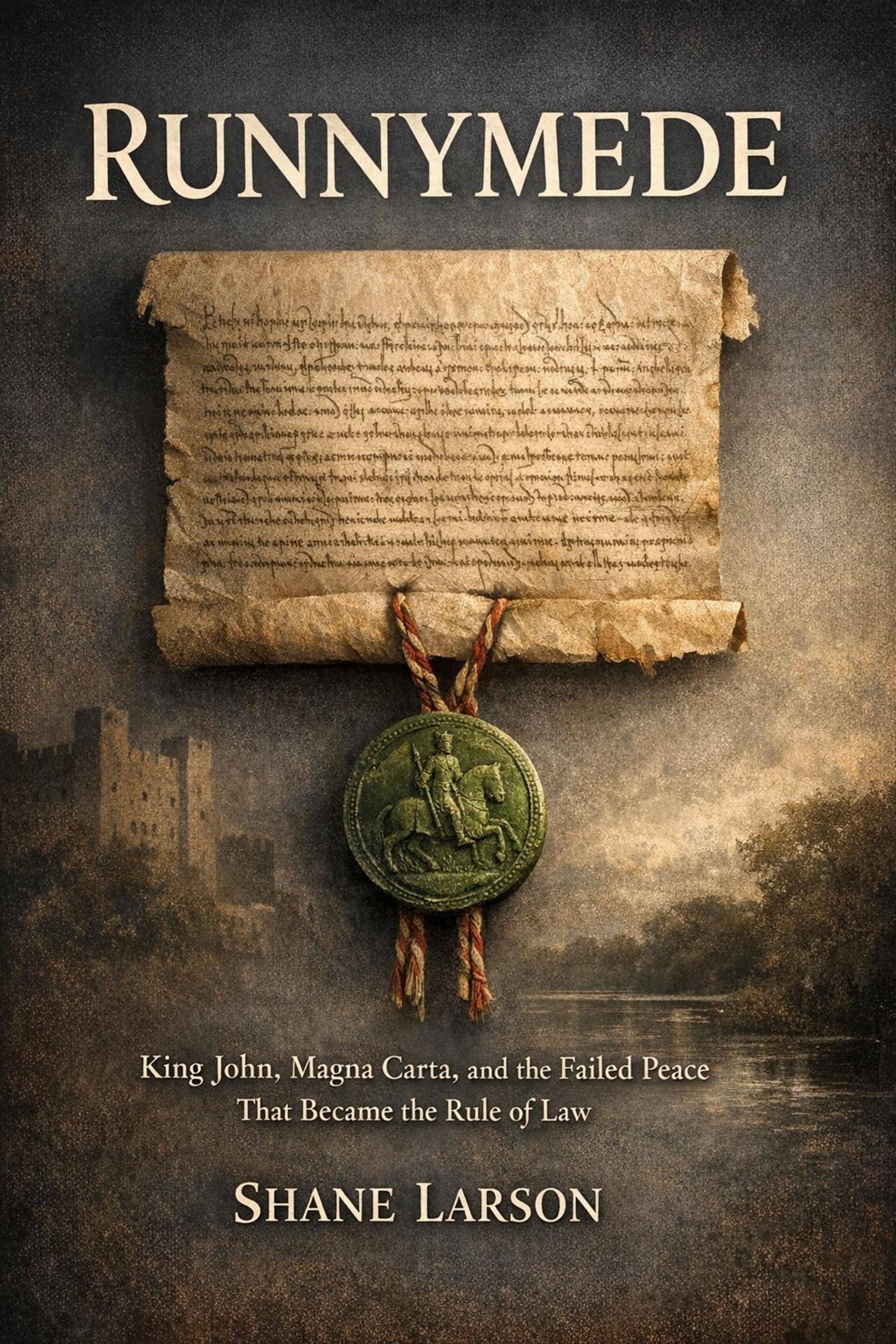
Runnymede: King John, Magna Carta, and the Failed Peace That Became the Rule of Law is a narrative history of the reign that produced the charter, the meadow where it was sealed, the war that followed its annulment, and the long second life in which lawyers, colonists and judges read into it things no baron of 1215 had put there. Chapter Seven walks the whole document in the book's own words, and an appendix gives every clause with its fate in each reissue. The witness is named in every scene, and the medieval text is kept apart from what was later made of it.
Runnymede
New posts and releases, straight to your inbox. No spam, unsubscribe anytime.