Herodotus Told the Most Outrageous Stories About the Scythians — and the Spade Keeps Proving Him Right
October 1, 2026 · 7 min read
Herodotus has been called the Father of History since Cicero, and the Father of Lies for nearly as long. No part of his work did more for the second title than Book Four, where he describes the Scythians — the horse-riding, herd-keeping peoples of the grassland north of the Black Sea, whom the Persians knew as Saka and the Assyrians, earlier, as the Ishkuzai. Even the name is an outsider's word: the peoples it covered, spread across five thousand kilometres of steppe, kept no writing and left no account of themselves. That made them the perfect screen for Greek invention, and Herodotus's reports read like invention. Kings buried with their strangled household staff. Enemies' skulls gilded into drinking cups. Felt tents in which mourners howled with pleasure at a vapour. Women who rode to war beside the men.
For two thousand years, careful readers filed all of it with the gold-guarding griffins and the one-eyed men, in the drawer marked travellers' tales. Then archaeologists started opening the burial mounds — and the most ridiculous claims turned out to be the reliable ones.
The tent, the stones, and the seeds
Start with the strangest report. After a funeral, Herodotus says, the Scythians purified themselves in a particular way. They leaned poles together into a small frame and stretched felt covers over it, sealing it tight. Inside they placed a dish of stones heated glowing-hot, and onto the stones they threw hemp seed, which smoked and steamed as no Greek bath ever did — and the Scythians howled with what he took for delight.
You can hear two dozen centuries of readers reaching the same verdict. At best, a garbled description of a steam bath by a man who had never been inside one. At worst, the standard slander of the barbarian: excess, noise, strange appetites. And there was no way to check. Felt rots. Wooden poles rot. Seeds decay. A practice made of perishable things and lasting an afternoon is the kind of claim history can never audit.
Except that in one corner of the steppe, the ground itself intervened.
The accident in the ice
In the Altai mountains of southern Siberia, at a place called Pazyryk, a group of large burial mounds was raided in antiquity. The robbers broke through the timber chamber roofs, took the metal, and left. Water followed them down through the broken roofs. Under the insulating rubble of the mounds, the soaked chambers froze, and the lens of ice never thawed again. In stripping the tombs of gold, the robbers had sealed everything they didn't want inside a freezer that ran for twenty-four centuries.
When Sergei Rudenko's Soviet teams excavated the mounds in the 1920s and 1940s — melting the chambers open with buckets of hot water, week after week — they lifted out a class of object that survives nowhere else in the ancient world. A knotted wool pile carpet, the oldest known. Felt wall hangings. A complete four-wheeled wagon. Saddles with their stuffing intact, clothing, a small table with its food in place. Horses in masks and antlered headdresses. Human bodies whose tattooed skin could still be read — deer and cats and composite beasts flowing over shoulders and arms in the same animal style worked into the gold.
And among the grave goods: poles for a small conical frame. A leather flask of hemp seeds. A bronze censer full of scorched stones — with charred seeds still among them.
It was the equipment, item for item — the actual kit Herodotus described, buried with the dead because it belonged to the rites of death, its stones still carrying the evidence of use. The howling tent was not a bath and not a slander. It was mourning — a rite of grief conducted in smoke — and a Greek writing four hundred years and three thousand kilometres from Pazyryk had described its apparatus almost to the object.
The funeral that read as pure invention
The tent is the cleanest confirmation. The royal funeral is the biggest.
Herodotus describes the death of a Scythian king as a catastrophe the whole steppe was made to feel. The body, preserved and dressed, was carted through the territories of the subject peoples, whose mourners cut their arms, cropped their hair, and drove arrowheads through their own hands. At the grave — a great chamber in the earth — the king was laid down and his household was sent with him: a concubine, a cupbearer, a cook, a groom, a messenger, all strangled, along with horses. Over it all a mound was heaped as high as the labour of thousands could raise it. And a year later, he says, came a second rite: fifty of the king's attendants were strangled, fifty horses were strangled, and the dead riders were mounted on the dead horses around the tomb on wooden frames — a motionless honour guard rotting in a circle on the open steppe.
The Scythians
No passage in Book Four was easier to disbelieve, and none has been more thoroughly vindicated by excavation. The great kurgans of the Pontic steppe — Chertomlyk, Solokha, Kul-Oba, Tolstaya Mogila — and their eastern cousins have produced the chambers, the lavish central burials, and, again and again, the rest of the cast: additional skeletons, without grave goods of their own, positioned as attendants; a groom lying among the horses; horse pits holding teams of sacrificed animals in their finery. At Arzhan, in Tuva, one early royal mound held over a hundred and fifty horses. The competitive mounds, the destroyed wealth, the strangled household — chamber by chamber, the ground has matched the report.
Honesty requires the other half of the audit. The anniversary tableau — the fifty mounted dead on their frames — has not been demonstrated, and being flesh and wood in open air, it may never be. The scorecard is not perfect, and Herodotus fails it regularly elsewhere: his geography wobbles, his numbers are nearly always useless, and he swallows folktales whole. That is exactly what makes the pattern in the confirmations worth taking seriously. This is not a man who is always right. He is a man who keeps being right about the things he should, by every scholarly instinct, be wrong about.
The women with the worn bows
One more, because it reaches past Scythia. Herodotus reports that among the Sauromatians, east of the Don, women rode and shot and went to war, and he attaches an origin legend involving shipwrecked Amazons. The legend is a story. The observation under it has become statistics: in some steppe cemeteries, roughly a fifth of the burials with weapons are, osteologically, female — women interred with quivers showing wear, with riding-adapted leg and hip bones, and in some cases with arrowheads lodged in body cavities. Not a nation of Amazons; the evidence stops well short of the legend. Women who rode, shot, fought, and were buried as what they had been — which is what a Greek observer, lacking any category for it, would have reported in exactly the tone he uses.
Why the ridiculous claims are the trustworthy ones
There is a pattern in what gets confirmed, and it changes how the rest of the text should be read.
Invented slander has a shape. A Greek inventing barbarians reaches for inversions of Greek norms — cruelty, appetite, disorder — and the details stay vague, because they only need to serve the rhetoric. What keeps being confirmed in Book Four is the opposite kind of claim: precise, mechanically specific, and rhetorically useless. Frame poles, felt covers, heated stones, a particular seed. A dead man's household enumerated by job title. No one invents a censer. These are the details of testimony, not of propaganda — things Herodotus heard, probably in the Greek trading city of Olbia, from people who had seen them and had no reason to embellish the plumbing of a funeral rite. The details that were too strange to serve as rhetoric, and too coherent on alien terms to be Greek imagination, were strange because they were true.
The steppe kept no archives. But the ground kept its own, in gold and ice, and on the claims we can now check, the verdict has run steadily in the old historian's favour. That is evidence about more than Scythia. Most of ancient history rests on reports that can never be audited. The one long ethnography where the audit can actually be run suggests our sources were listening more carefully than two centuries of suspicion allowed.
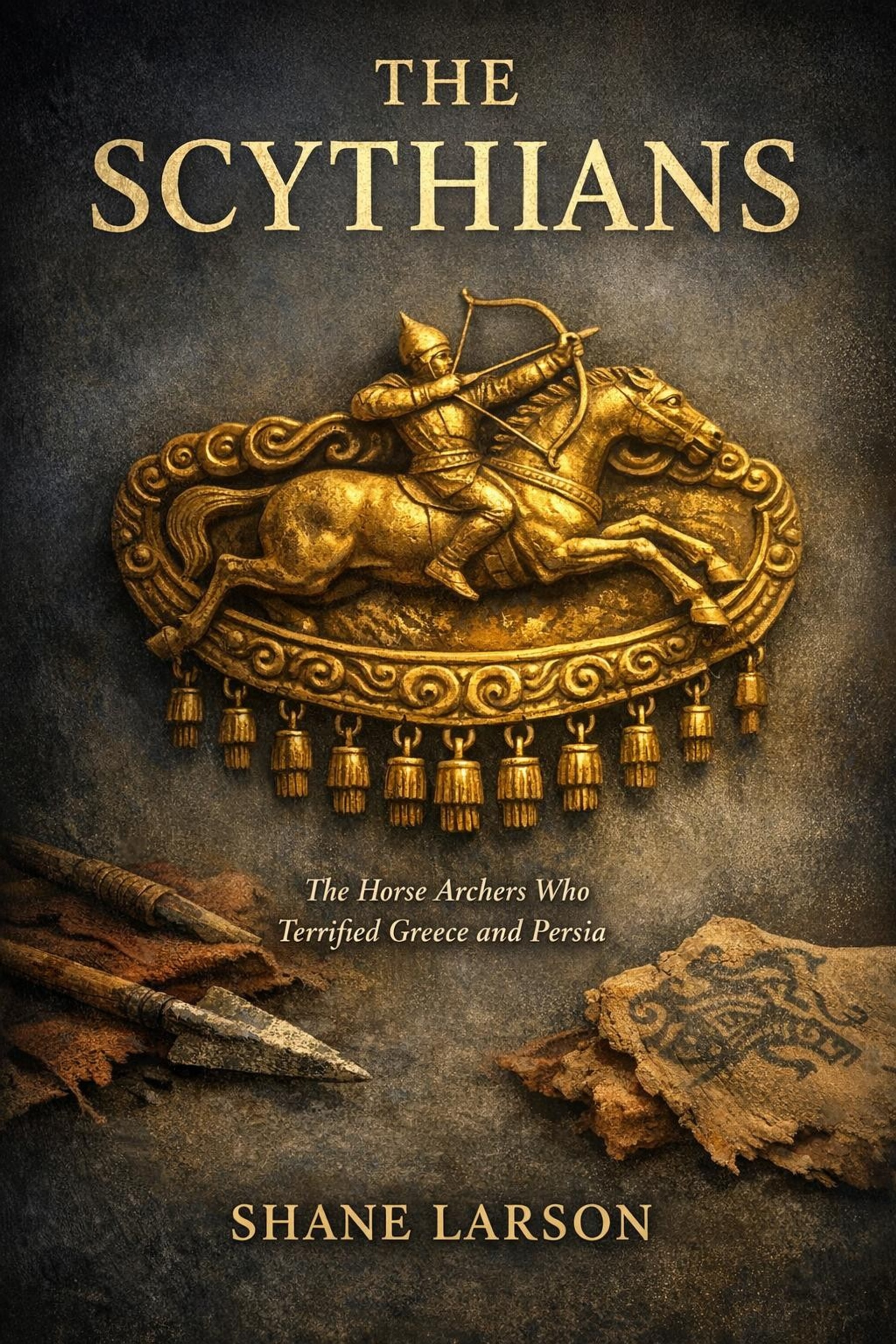
This article draws on my book The Scythians: The Horse Archers Who Terrified Greece and Persia, which tells the whole story — the campaign in which Darius invaded the steppe with the largest army on earth and never found anyone to fight, the gold of the great kurgans, the frozen tombs and the tattooed chieftains, and the way of war the Scythians invented that kept defeating settled empires for two thousand years. It belongs on the same shelf as Attila and The Mongol Storm. If a historian vindicated by a freezer accident sounds like your kind of history, the book is available in ebook and paperback.
The Scythians
New posts and releases, straight to your inbox. No spam, unsubscribe anytime.