The Last King of Judah Is on a Babylonian Ration List
November 16, 2026 · 6 min read
The Book of Kings ends in an odd place. Its last chapter tells the worst thing that ever happened to the kingdom of Judah: Jerusalem besieged and starved, the wall breached, the temple of Solomon burned, the people marched off to Babylon. A reader expects the book to stop there, on the ruin. It adds four more verses about a man the story dropped twenty-six chapters of history earlier.
His name was Jehoiachin. He had been king of Judah for three months in the winter of 598/597 BC, when he was eighteen, and he had surrendered Jerusalem to Nebuchadnezzar and been taken to Babylon as a prisoner. The last verses of Kings report that thirty-seven years later a new king of Babylon let him out, gave him a seat at the royal table, and put him on a pension. In the King James Version the book's final sentence reads: "And his allowance was a continual allowance given him of the king, a daily rate for every day, all the days of his life" (2 Kings 25:30).
For most of the time people have been reading that verse, there was no way to check it. Then a German excavation and a patient Assyriologist turned up the paperwork.
What Koldewey found and Weidner read
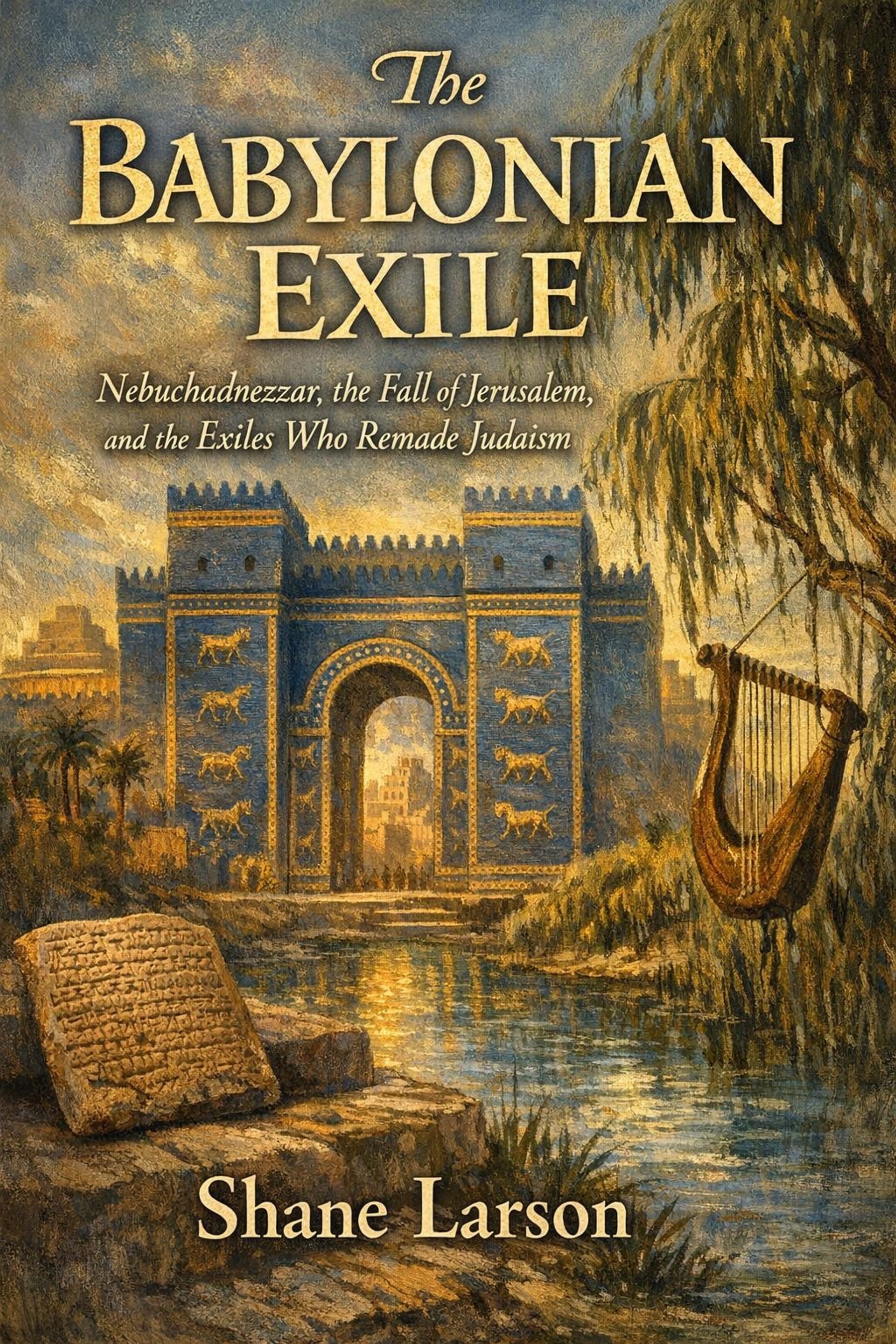
Robert Koldewey dug at Babylon for the German Oriental Society from 1899 to 1917. Most of what he uncovered belonged to Nebuchadnezzar, who rebuilt the city so thoroughly that his walls, gates and palaces were what lay on top. At the north-east corner of the Southern Palace, near the Ishtar Gate, the excavators cleared a block of thick-walled vaulted rooms and found in it an archive of roughly three hundred clay tablets.
They were not the kind of tablets museums put on display. They were storehouse records: lists of oil and barley issued to people the palace was feeding, each with a name and a quantity. The dated ones run from Nebuchadnezzar's tenth year to his thirty-fifth, 595 to 570 BC. They were shipped to Berlin and left largely unread for a generation.
In 1939 Ernst Weidner published a selection. Among the people drawing oil from Nebuchadnezzar's stores he found a man the scribes called Ya'ukinu, with the title king of the land of Yahudu. The spelling shifts from tablet to tablet, as foreign names do in cuneiform, but there is no real doubt who it is. Other entries record oil for the five sons of the king of Judah, handed to an attendant who had charge of them. One tablet carries a date equivalent to 592 BC, five years after the Bible says Jehoiachin was deported.
A Babylonian clerk who had never heard of the Book of Kings, and a Judean writer who never saw the palace accounts, were describing the same hostage.
What the tablets do and do not prove
It is worth being exact about this, because the find is often oversold.
The tablets confirm that Jehoiachin was in Babylon, alive, in the 590s; that the Babylonian administration still called him king of Judah after it had put someone else on his throne; that he had sons there; and that he was being provisioned by the crown. The biblical account says all of that or implies it.
They do not record his release. The archive stops in 570, and Kings puts the release in 561, in the first year of Nebuchadnezzar's successor, the king the Bible calls Evil-merodach and the Babylonian records call Amel-Marduk. The tablets show a king being maintained, not a king being freed. They also raise a question nobody can answer. Kings says he was brought out of prison. A man receiving generous oil rations for himself and his household in 592 does not look like a man in a cell. Something may have changed in between, perhaps when his uncle Zedekiah rebelled and brought the Babylonian army back to Jerusalem. There is no evidence either way.
The Babylonian Exile
What the tablets do show, and what nobody expected, is the company he kept. The same lists feed the sons of a king of Ashkelon, sailors and craftsmen from the Phoenician cities, Egyptians, Medes, Persians, Lydians, and Greek carpenters from Ionia. Nebuchadnezzar's court kept a collection of the conquered: royal hostages who guaranteed their countries' good behaviour, and skilled foreigners put to work. The king of Judah was one entry among many.
The date in the Chronicle
The ration tablets are not the only place the two records meet. The Babylonians kept terse year-by-year chronicles of what their kings did, and the tablet covering Nebuchadnezzar's early reign, now in the British Museum, was published in 1956. For his seventh year it reports that the king marched west, besieged "the city of Judah", took it on the second day of the month of Adar, captured its king, installed a king of his own choosing, and carried off heavy tribute.
The second of Adar in that year falls in mid-March 597 BC. The Book of Kings tells the same event from inside the walls: Jehoiachin going out to the king of Babylon with his mother, his servants and his officers, and his uncle being made king in his place. It is one of the few moments in the Hebrew Bible that can be dated to the week from an independent source.
Ten years later that uncle rebelled, and here the Babylonian record fails. The chronicle series breaks off in 594 and does not resume for a generation. For the final siege and the burning of Jerusalem there is no Babylonian narrative at all. There are the biblical writers, a handful of letters written in ink on broken pottery by Judean officers in the last months, and the destruction layer itself: burnt rooms, collapsed walls, and arrowheads.
Why the book ends there
So why does Kings end with the pension? Readers have given two answers. One is that it is a deliberate note of hope: the line of David is not finished, its heir is alive and honoured, and the story is not over. The other is plainer. It may simply be the last thing the writer knew.
Either way the choice turned out to be right about what mattered. The exile is remembered as a lament, and with reason: Psalm 137 has the captives sitting down by the rivers of Babylon and weeping when they remembered Zion. But the tablets belong to a second kind of evidence, which has grown a good deal in the last few decades. Some two hundred contracts from a Babylonian village named for its deportees, "Judahtown", show Judean families over four generations leasing land, paying taxes, borrowing silver, and giving their children names built on the name of their God. They were captives. They were also farmers with paperwork.
A grandson of the man on the ration list, with the thoroughly Babylonian name Zerubbabel, later led a party of exiles back to Jerusalem to rebuild the temple. Most of his people did not go with him. They stayed where their grandparents had been settled, and their descendants were still there a thousand years later.
The last line of Kings and a line on a clay tablet record the same daily ration. *The Babylonian Exile* is the story of what happened between the fall of the city and that small entry in the accounts, and of how a people that had lost its king, its land and its temple outlasted the empire that took them.
Related reading: Babylon on the city Koldewey excavated, and The Persian Empire on Cyrus and the end of the exile.
The Babylonian Exile
New posts and releases, straight to your inbox. No spam, unsubscribe anytime.