Plato Stopped Writing Mid-Sentence. We Have Spent 2,400 Years Finishing Atlantis for Him.
October 7, 2026 · 7 min read
Zeus has gathered the gods. He has looked down at an island empire that was once virtuous and has grown greedy, he has decided to punish it, and, in Benjamin Jowett's 1871 translation, "he spake as follows—"
That is the end. Not of a paragraph: of the book. Plato's Critias, the dialogue that was going to tell the story of Atlantis properly, stops with the god's mouth open. No ancient reader claims to have seen more of it. No manuscript continues it. Plato lived on for years and wrote the longest of his works in them, and he never went back.
Everything the ancient world recorded about Atlantis fits in about twenty pages of two dialogues, and one of those pages ends in a dash. Set that against what followed. Several hundred locations have been proposed, on every continent and under every ocean, Antarctica and the Sahara included. There have been expeditions by sail, by submersible, by sonar and by satellite. A book about it by a Minnesota congressman has barely been out of print since 1882. The Atlantis shelf in a large bookshop is longer than the one for Mesopotamia, which existed for three thousand years.
I spent a book on that disproportion, and the thing I came away convinced of is that the unfinished sentence is not a footnote to the Atlantis story. It is the reason there is one.
There is no source but Plato
Start with the fact that decides most of the argument before it begins. No Greek writer before Plato mentions Atlantis. Herodotus, who travelled in Egypt a generation earlier and wrote down what the priests told him with an appetite for marvels his critics never forgave, does not mention it. No Egyptian document mentions it, in any period. No Near Eastern text, no Mycenaean tablet, nothing. Every ancient author who discusses Atlantis after Plato is discussing Plato, and says so.
The story does come with a provenance. Critias, the character who tells it, says he had it from his grandfather, who had it from Solon, who had it from the priests of Saïs in Egypt, who read it off temple records thousands of years old. It is an impressive chain of custody, and every link in it is inside the dialogue. You cannot step outside the text to check any of it. That is where provenance goes when it is being manufactured, and Plato, who distrusted poets precisely because they made things up and called it truth, knew what he was doing.
Then there are the numbers. The island, in Jowett's rendering, "was larger than Libya and Asia put together," which to a Greek meant larger than North Africa and the Near East combined. It flourished nine thousand years before Solon, which puts it around 9600 BCE, when the people of Greece were hunting with flint. Readers who want Atlantis to be real tend to fix those numbers first, dividing by ten and moving the Pillars of Heracles, and I will come back to that move. For now, notice only that the one source we have describes something that could not have existed, and tells us so in plain figures.
It was written to lose
Why would a philosopher invent a continent?
Because he needed an enemy. The Timaeus and Critias were planned as a sequel to the Republic: the ideal city described there in theory was to be shown in action, and a city shown in action needs an adversary worth beating. So Plato built one. Atlantis is rich where the ideal city is austere, maritime where it is landlocked, imperial where it is self-contained. It sends a fleet across the Mediterranean, and a small, virtuous, primeval Athens defeats it alone. Then the gods remove both from the map "in a single day and night of misfortune."
Plato was writing this in his seventies, as a citizen of a city that had done exactly what Atlantis does. Athens had built a maritime empire, taxed an archipelago, launched one expedition too many against an island city, Syracuse, and lost its fleet, its army and eventually its walls. The man who wrote Atlantis had lived through his own country being Atlantis, and had buried a teacher that country executed. The sea empire that grows arrogant and is punished is not a memory he received from Egypt. It is a memory he had.
Atlantis
That is also why the island has to sink. A thought experiment with a real address can be visited, and if the reader can go and check, so can the Athens that beat it. Both vanish in the same catastrophe. Aristotle is reported, through Strabo, to have remarked that the man who invented Atlantis also made it disappear. It was a joke at his teacher's expense, and it is the most accurate sentence anyone has written on the subject.
The drowned city two days from his door
None of which means Plato made it from nothing. Myths are almost never made from nothing; they are assembled. And one of the pieces he had to hand is badly under-used in the popular accounts.
In the winter of 373 BCE, when Plato was in his fifties and living in Athens, a Greek city on the southern shore of the Gulf of Corinth called Helike was destroyed in a single night. An earthquake brought the buildings down and the sea came in over them. The ancient accounts say the city went under with its people, and that for centuries afterward the ruins could be seen beneath the water. Later writers reported a bronze Poseidon still standing among them, where the ferrymen's nets caught on it.
Helike was roughly two days' travel from Plato's door. He was writing the Atlantis dialogues perhaps fifteen years after it happened. A wealthy city that the sea takes in a night was not, for him, an exotic hypothesis. It was the news, and recent news, the kind every Athenian of his generation had heard discussed.
Helike itself has a sequel worth knowing. People looked for it from antiquity onward, divers and archaeologists among them, and found nothing under the gulf. It was located in 2001, by Dora Katsonopoulou and Steven Soter, not under the sea at all but under the coastal farmland, where silt had buried it after the shoreline moved. The real drowned city was found by starting from the material and asking where it went. The imaginary one has never been found, because the method runs the other way: begin with the answer, discard the parts of Plato's description that do not fit your site, keep the parts that do, and call the residue a match. That move works on Santorini and on Antarctica, which is why it proves nothing about either.
Why the sentence stayed unfinished
A thought experiment with the lid on should have stayed where Plato left it. For seventeen centuries it very nearly did. What changed was not evidence; nothing has ever been found. What changed was that people arrived who needed the story, and the story had no ending, so it could be given whichever ending they required.
The Renaissance had just found a continent in the Atlantic and wanted the ancients to have known about it. The Victorians had watched Schliemann dig up Troy and reasonably wondered which legend would be vindicated next, and Ignatius Donnelly's 1882 bestseller supplied one. A spiritual movement wanted a prehistory for the soul. A nationalist one wanted a prehistory for a race, and the second grew out of the first in ways most modern enthusiasts have never traced. A Cold War navy had mapped the seafloor for other reasons and found itself with instruments pointed where the story said to look. A streaming service needs it now for the plainest reason of all: a mystery holds attention and a correction releases it.
None of those endings is in the text. All of them are in the blank after the dash. That, I think, is the actual answer to why Atlantis will not sink. It is not that people are credulous; most of the people who looked were not. It is that Atlantis supplies something no real history does: a golden age, destroyed in a day for its sins, by a judgement that was deserved. Real civilizations end slowly, for structural reasons, with no villain and no moral. Atlantis is the shape we prefer. Plato gave the oldest story in the world an address, then declined to say what the god said, and we have been saying it for him ever since.
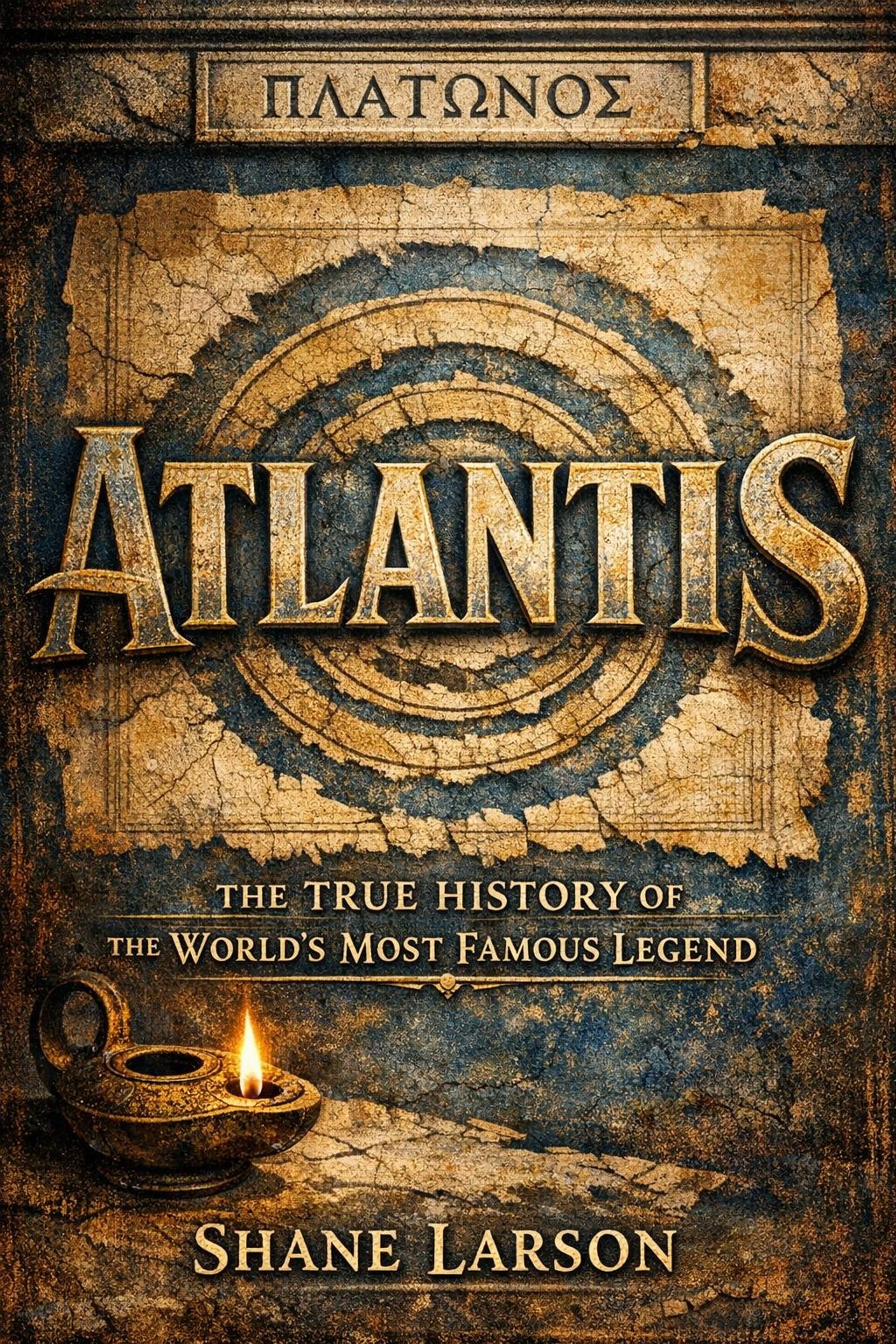
*Atlantis: The True History of the World's Most Famous Legend* is available now in ebook and paperback. It is the third volume of the Minoan arc, after *The Minoans* and *Thera*, and it reads cold for anyone arriving here first. It will not find Atlantis. It will show you what the story is made of, and where the real drowned cities are.
Atlantis
New posts and releases, straight to your inbox. No spam, unsubscribe anytime.