What Happened in the Great Famine of 1315? Two Years of Rain, One Person in Ten, and the Famine Before the Black Death
November 12, 2026 · 8 min read
Search for the Great Famine and you get Ireland in the 1840s, and that is reasonable: it is nearer, it is better documented in the modern sense, and it has a national history keeping it present. But there is an older Great Famine, and it was bigger. Between 1315 and 1317 the harvests failed across the whole of northern Europe, from Ireland in the west to Poland in the east and from Scotland south to the edge of the Alps, and something like one person in ten may have died. It gets about a paragraph in most history books, at the start of a chapter on the Black Death. Here is what that paragraph stands in for.
It rained from Pentecost, and then it rained again
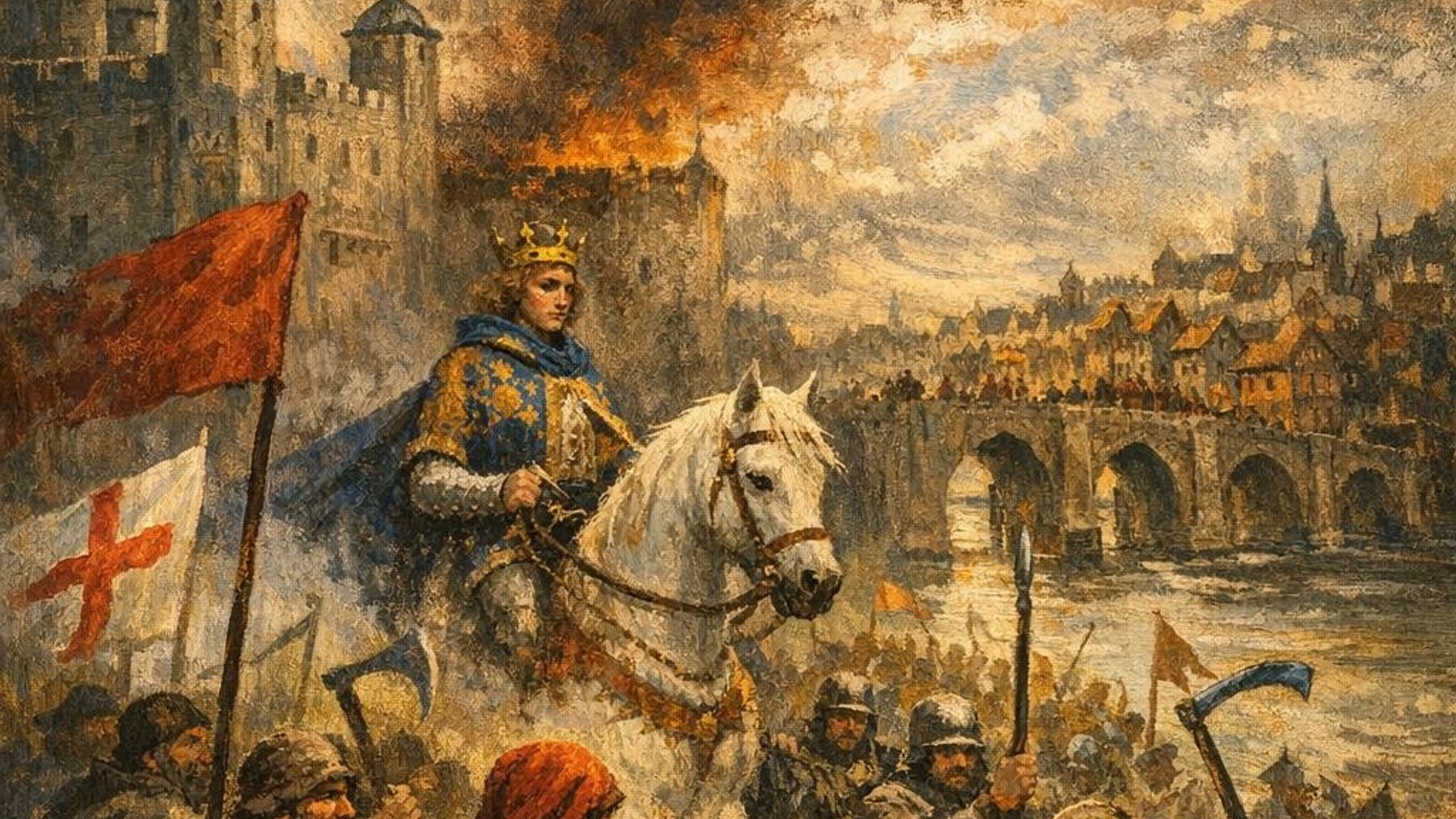
The chroniclers who date the start put it around Pentecost 1315, which fell in the middle of May, and they agree, in Latin, French, Flemish, German and Irish: that it rained through the summer, that the fields stood in water, that the corn did not ripen and what could be cut could not be dried. Hay rotted in the meadows. The coastal salt pans, which worked by evaporation, produced no salt, and salt was what kept meat and fish through to spring. Peat and firewood would not dry. That autumn Louis X of France marched an army into Flanders and it sank into the mud of the Lys near Courtrai and went home without fighting.
Then the harvest of 1316 failed as well, and failed worse, because the reserves were gone and the seed had been eaten. The harvest of 1317 was poor. Only in 1318 did northern Europe bring in a crop that could be called ordinary. By then the animals were dying too.
How many died, and why nobody can say
No one counted. The figure historians give is built from fragments: burial payments, manorial death duties, gaps in rent rolls. The most common estimate is something like one person in ten across the whole northern zone; some put it lower, around five per cent, and some put it higher in particular places. The one hard number in wide circulation is from Ypres, the Flemish cloth town, whose accounts record payments for collecting 2,794 bodies from its streets between May and October 1316. The town's population at the time was perhaps twenty to thirty thousand. It is often quoted as a tenth of the town, and it may be; but it counts bodies the town paid to remove, nothing else.
The pattern of who died is clearer than the total. The famine killed in Flanders, which bought its grain, worse than anywhere the records let us see. It killed in towns more than in the countryside, and it killed the landless and the smallholders who lived on wages and bought their bread.
Why money did not help
The odd thing about the Great Famine is where it fell. This was the richest, most commercial, most heavily documented Europe there had yet been. It had market towns in every district, Italian banks lending to kings, and manorial accountants recording every bushel sown and reaped.
None of it helped. A market can move grain from where it is to where it is wanted, and in 1315 and 1316 the markets of northern Europe did exactly that; but in a general shortage the grain moves towards whoever can pay, and the people who could not pay were the majority. Wheat in England rose to three or four times its normal price, and chroniclers in some places and months report forty shillings a quarter against an ordinary five or six, though those are chroniclers' figures and local ones. A labourer's wage did not rise at all, because there were more labourers than work. In August 1315 Edward II stopped at St Albans and his household could scarcely find bread to buy. He was not poor. There was no bread. Edward tried that year to fix the price of meat and poultry by ordinance, and found that fixed prices had emptied the markets; the ordinance was withdrawn within a year. Mediterranean grain came north by sea and Baltic grain came west through the Hanse ports, at famine prices, and none of it closed a gap the size of two harvests.
Then the sheep died, and then the cattle
The animal plagues get less attention than the grain and may have done more lasting damage. The sheep went first, from 1315, to the rot and liver fluke that standing water brings. Then, from 1319 in England, came the cattle plague, from central Europe; the disease was probably rinderpest, though that is a leading candidate rather than a proven identification. Losses on some estates ran to half the herd or more, on the estimates historians have made from the accounts. An ox is not a crop. A herd that has lost half its animals has to be bred back from what is left, and until it is, the ploughs are short of traction, the fields are short of manure, and the children are short of milk.
The Drowned Harvest
War and fear made it worse
The famine did not arrive alone. In May 1315 Edward Bruce, brother of the king of Scots, landed in Ulster with an army and fought a war through the hungry years until he was killed at Faughart in October 1318; the Irish annals record armies eating the country and the country starving. Across the water, the north of England, exposed since Bannockburn, was raided and blackmailed by the Scots while a king at odds with his greatest earl could neither defend it nor feed it. And in France, as the crisis ran on, fear went looking for a cause. In 1320 a popular crusade of shepherds and peasants, the Pastoureaux, marched south and massacred Jews in a string of towns. In 1321 an accusation spread that lepers were poisoning wells, confessions were taken under torture, lepers were burned, and the story grew to take in the Jews as well. The well-poisoning charge returns in 1348; 1321 looks very much like its rehearsal.
What the chroniclers claimed, and what that is worth
The monks who wrote the chronicles inherited a tradition of famine description that ran back through earlier medieval writers to Josephus on the siege of Jerusalem and behind him to Deuteronomy and Lamentations. A famine, in that tradition, had a fixed set of images: the poor eating dogs and horses, the dead unburied, and at the end, cannibalism. Several chroniclers of 1315 to 1317, in England, Ireland and the Baltic, reached for those images. That does not make the claims false, but it does not make them true either. It means the writer knew what a famine was supposed to look like and was telling his readers that this was one. None of the reports can be checked against any other kind of record. The same goes for the claim, common online, that Hansel and Gretel remembers 1315: the Grimms collected the tale in the early nineteenth century, it belongs to a type found across Europe, and no document links it to this famine. The numbers tell us what happened. The horror stories tell us what people feared and how monks wrote.
Why it rained
Contemporaries thought God had sent the weather. Modern science has candidates rather than an answer. The rains fall at the end of the long warm stretch now called the Medieval Climate Anomaly and near the start of the cooling called the Little Ice Age, during a period of low solar activity known as the Wolf minimum, roughly 1280 to 1350. A volcanic trigger has been proposed, an eruption at Kaharoa in New Zealand around 1314, but the case has problems of size, latitude and dating and is weaker than the volcanic case for 1258 or for 1816. The honest limit is this: climate science can describe a trend over a century with some confidence and cannot easily say why two particular summers were wet. Some of it may simply have been chance.
The famine before the Black Death
The reason to care about all this is what came thirty years later. In 1348 and 1349 London opened an emergency cemetery at East Smithfield for the plague dead, excavated in the 1980s. The skeletons have since been read for the marks that childhood hunger leaves in bone and teeth, and the argument that has grown from that work, advanced by Sharon DeWitte, Philip Slavin and others, is that the plague did not kill at random: that the adults who died were disproportionately those who had been malnourished as children, and that the children malnourished in England between 1315 and 1322 were precisely the adults of 1348. It is a new argument, a disputed one, and it rests on evidence with real limits, since a mark in a bone can record a survivor rather than a weakling. But if it is even partly right, the famine is not background to the plague. It is part of the mechanism.
Which is also why the famine was forgotten. The plague did not just exceed it; it overwrote it, in the sense that the people who would have been its historians were writing in the plague's shadow or died in its first year. The famine got no iconography, and when it finally got a name in English, in a long article of 1930 and a scholarly monograph of 1996, the name had already been taken by Ireland.
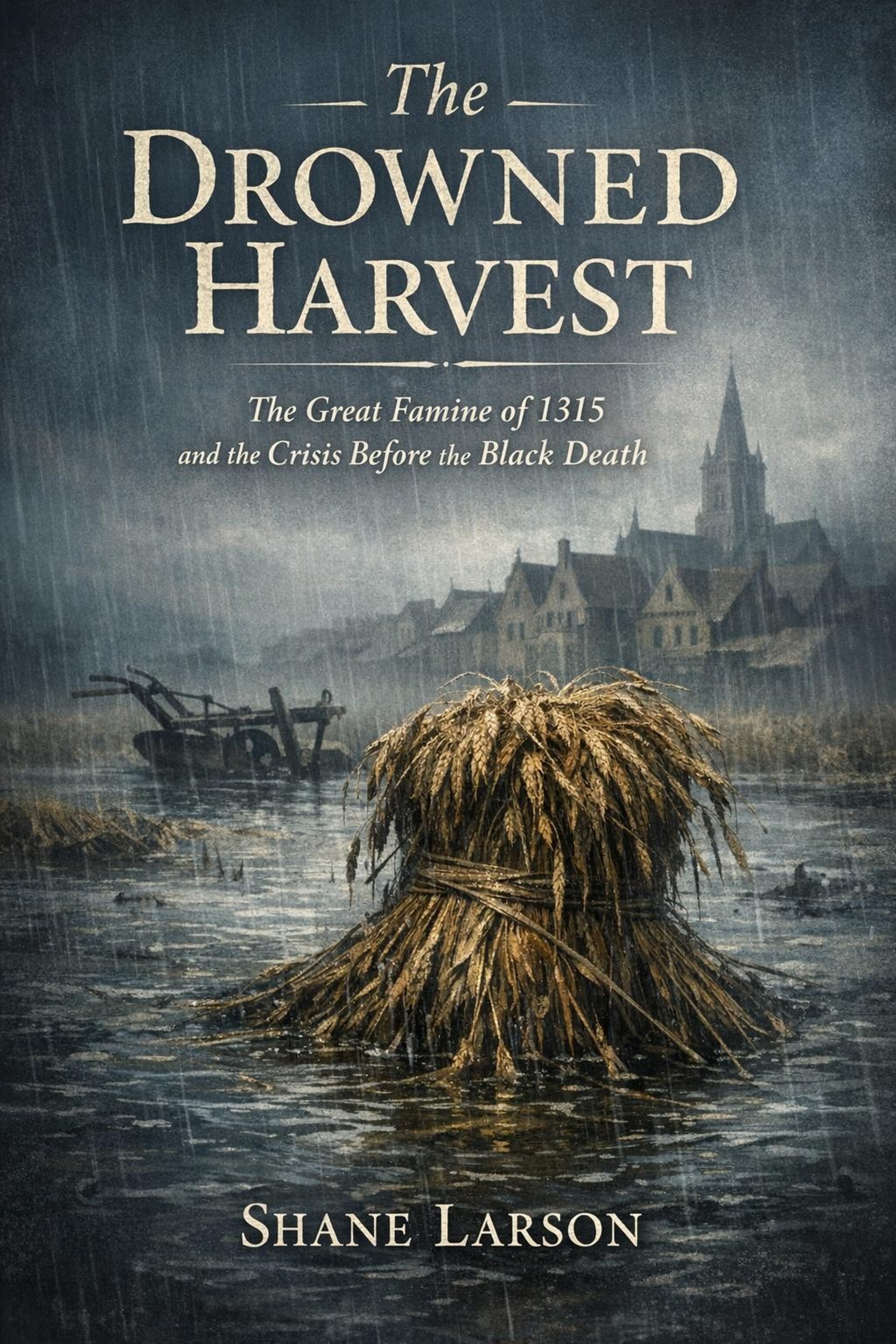
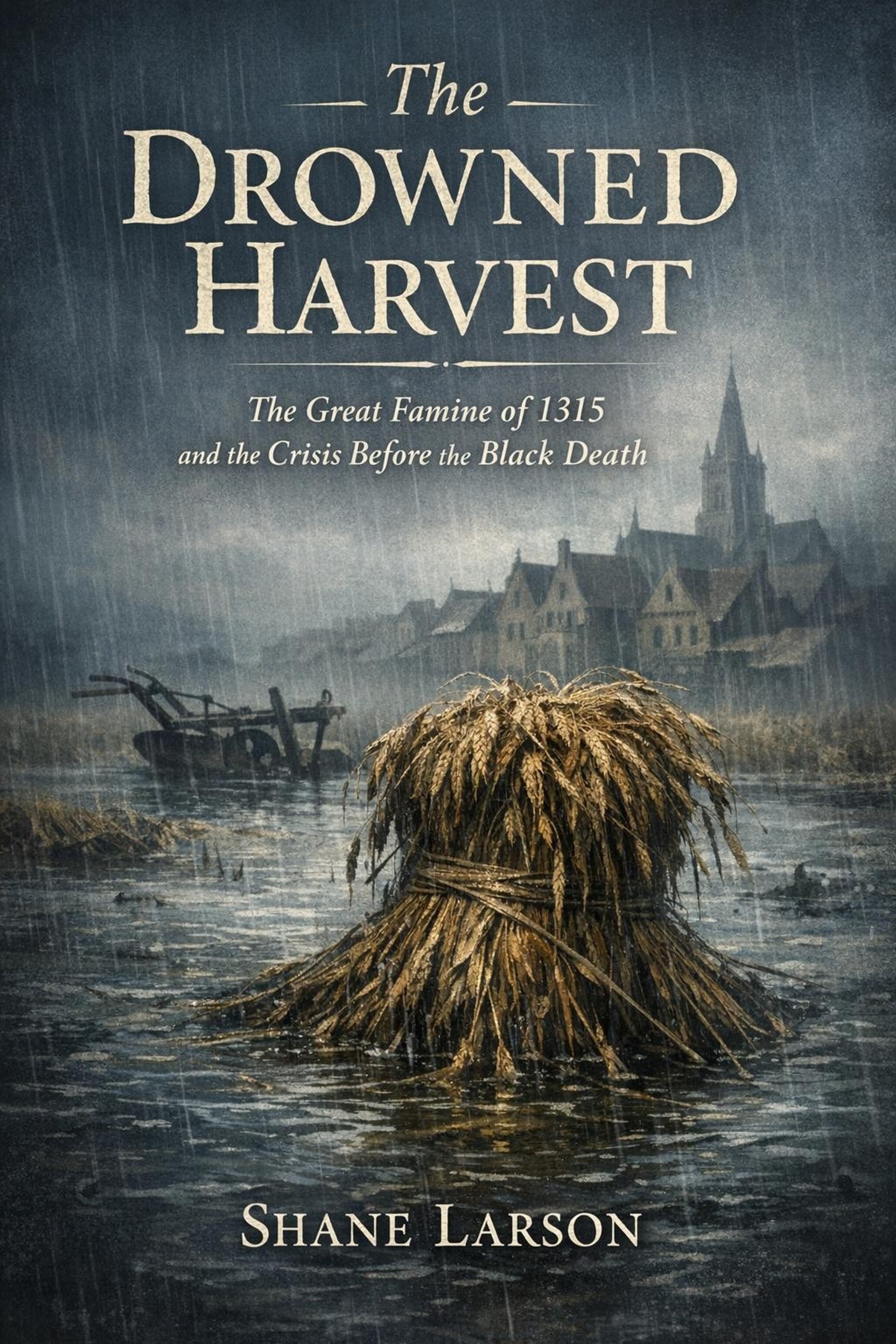
*The Drowned Harvest: The Great Famine of 1315 and the Crisis Before the Black Death* is a narrative history of the famine at three speeds: the full granary of the Europe that grew for three centuries before the rain, the three wet years told season by season from the manorial accounts, the price series and the town ledgers, and then the long shadow of war, animal plague, scapegoating and failed recovery that ends in 1347 with the plague galleys not yet at Messina. It names the witness in every scene, keeps the numbers and the horror stories apart, and says each time what a figure counts and what it does not. It was written to stand in front of *The Black Death*, and it ends where that book begins.
The Drowned Harvest
New posts and releases, straight to your inbox. No spam, unsubscribe anytime.