Did Basil II Really Blind 15,000 Bulgarian Prisoners? What the Sources Say About Kleidion
November 13, 2026 · 6 min read
The best-known story about the Byzantine emperor Basil II goes like this. On 29 July 1014 his army trapped a Bulgarian force in a mountain pass called Kleidion and took most of it prisoner. Basil had the captives blinded, fifteen thousand of them, leaving one man in every hundred a single eye so that he could lead the others home. When the column reached Tsar Samuel, the old king collapsed at the sight. He died two days later, on 6 October.
It is a story built to be remembered, and it has been, for most of a thousand years. It gave Basil the name he is known by: Boulgaroktonos, the Bulgar-Slayer. The question is how much of it the evidence will carry.
Where the story comes from
Nearly everything in that paragraph rests on one writer. John Skylitzes was a senior judge in Constantinople who compiled a history of the emperors from 811 to 1057. He wrote it in the later eleventh century, something like seventy years after Kleidion, working from earlier accounts that no longer survive. For the long war between Basil and Samuel he is very nearly the only narrative source there is.
A second writer of roughly the same date supports him in outline. Kekaumenos, a retired soldier who wrote a book of advice for his sons in the 1070s, mentions the blinding in passing and gives the number as fourteen thousand. The difference between the two figures matters less than the fact that both men, writing independently, had heard of a mass blinding on that scale. Something happened in that pass that people were still talking about two generations later.
Who does not mention it
The trouble starts with the writers who were closer.
Yahya of Antioch was a Christian physician writing in Arabic, a contemporary of Basil's, and his chronicle is usually the most reliable source for the reign's dates. He records the Bulgarian war and its end. He does not record fifteen thousand blinded men.
Michael Psellos, the most famous Byzantine writer of the eleventh century, left a vivid portrait of Basil: the plain dress, the soldier's speech, the suspicion of everyone around him. Psellos was born in 1018 and grew up among people who had served the emperor. He says almost nothing about the Bulgarian war, and nothing about Kleidion.
Silence is weak evidence. Yahya lived in Syria and cared most about the eastern frontier. Psellos was writing a character study, not a military history. Neither man's omission proves the event did not happen. But for an act supposedly so shocking that it killed a king, the quiet is worth noticing.
The problem with the number
Historians who doubt the figure usually start with arithmetic. Fifteen thousand prisoners would have been a very large share of any army Samuel could put in the field, perhaps most of it. Yet his state did not fall in 1014. Within weeks of Kleidion a Bulgarian force under Samuel's son ambushed and killed one of Basil's senior commanders, Theophylact Botaneiates, and the emperor broke off his advance. The war then went on for four more years, through two more Bulgarian rulers, and ended in 1018 only when the last of them was killed outside the walls of Dyrrachium.
A state that had just lost fifteen thousand soldiers in an afternoon would have been hard pressed to do any of that. On this reasoning the real number was a fraction of the reported one, and it grew in the retelling, as round numbers in medieval chronicles tend to.
Basil II
There is a counter-argument, and it deserves a fair hearing. Blinding was an established Byzantine punishment, used on rebels and deposed emperors because it disabled without killing. Basil's government regarded Samuel's subjects as rebels against Roman authority, and treating them as such would have been consistent with law and custom as the court understood them. The men blinded need not all have been front-line soldiers. And two writers do give figures within a thousand of each other. Several historians accept that the mutilation was carried out on a very large scale, even if not literally to the last man of fifteen thousand.
The evidence does not settle it. What it supports is this: a large number of prisoners were blinded after Kleidion, the exact number is unknown, and the figure everyone repeats is one chronicler's, set down long afterward.
The name came later still
Whatever happened in the pass, it did not earn Basil his nickname at the time. No source written during his life calls him the Bulgar-Slayer. Neither does Psellos, and neither does Skylitzes. To tell him apart from the earlier emperor Basil I, writers of the eleventh century called him things like the younger Basil, or Basil born in the purple.
The epithet appears in the later twelfth century, more than a hundred and fifty years after his death. The timing is not an accident. In the 1180s a new Bulgarian state broke away from the empire, and the two were at war again. The historian Paul Stephenson has argued that this was when Byzantines went looking for an emperor who had beaten the Bulgarians, and gave him a name to match.
Its modern fame is more recent. In the early 1900s, when Greeks and Bulgarians were fighting over Ottoman Macedonia, the medieval emperor was pressed into service, and a children's novel published in 1911 fixed him in Greek memory as a national hero. In Bulgaria the same events are remembered as a national tragedy.
What the legend leaves out
The oddest thing about the story is how poorly it fits what Basil did next. After the final surrender in 1018 he did not dismantle the conquered country. He left its church under an archbishop of its own at Ohrid. He let its people go on paying their taxes in kind, as they had under Samuel, instead of demanding coin. He gave Samuel's surviving family and nobles court titles, commands and marriages into the Byzantine aristocracy.
None of that undoes what was done at Kleidion. It does suggest that the emperor was pursuing something other than slaughter for its own sake, and that a name coined a century and a half later is a poor guide to him.
The rest of his life is at least as strange as the legend. He was crowned at two and kept from power until his late twenties. He lost his first battle. He survived two civil wars by trading his sister's hand to a pagan prince of Kyiv for six thousand Norse soldiers, the bargain told from the northern side in The Rus. He never married, campaigned almost every year for three decades, and died with a full treasury and no heir. Four centuries later the empire he enlarged ended at the walls of its capital, which is the subject of The Fall of Constantinople.
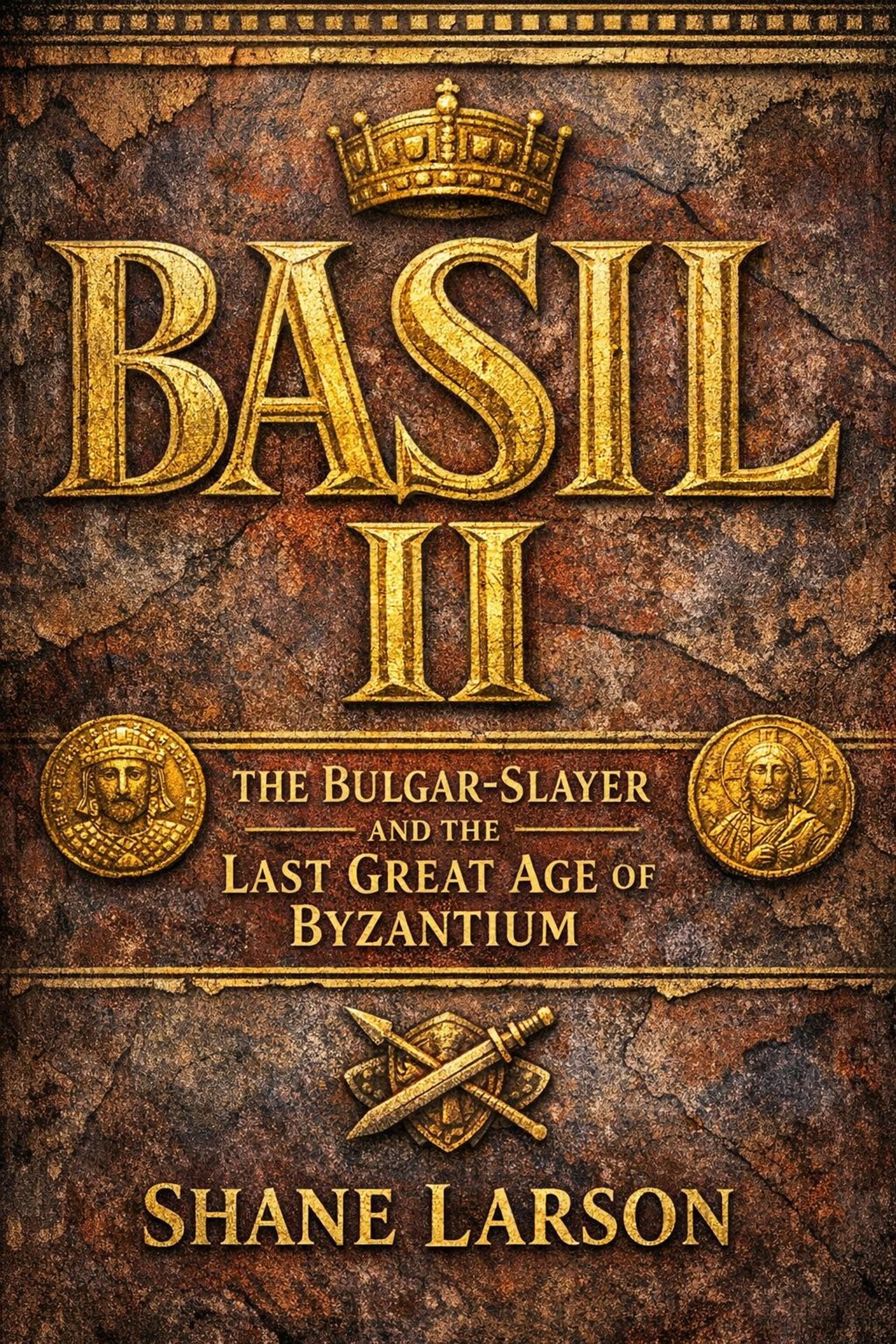
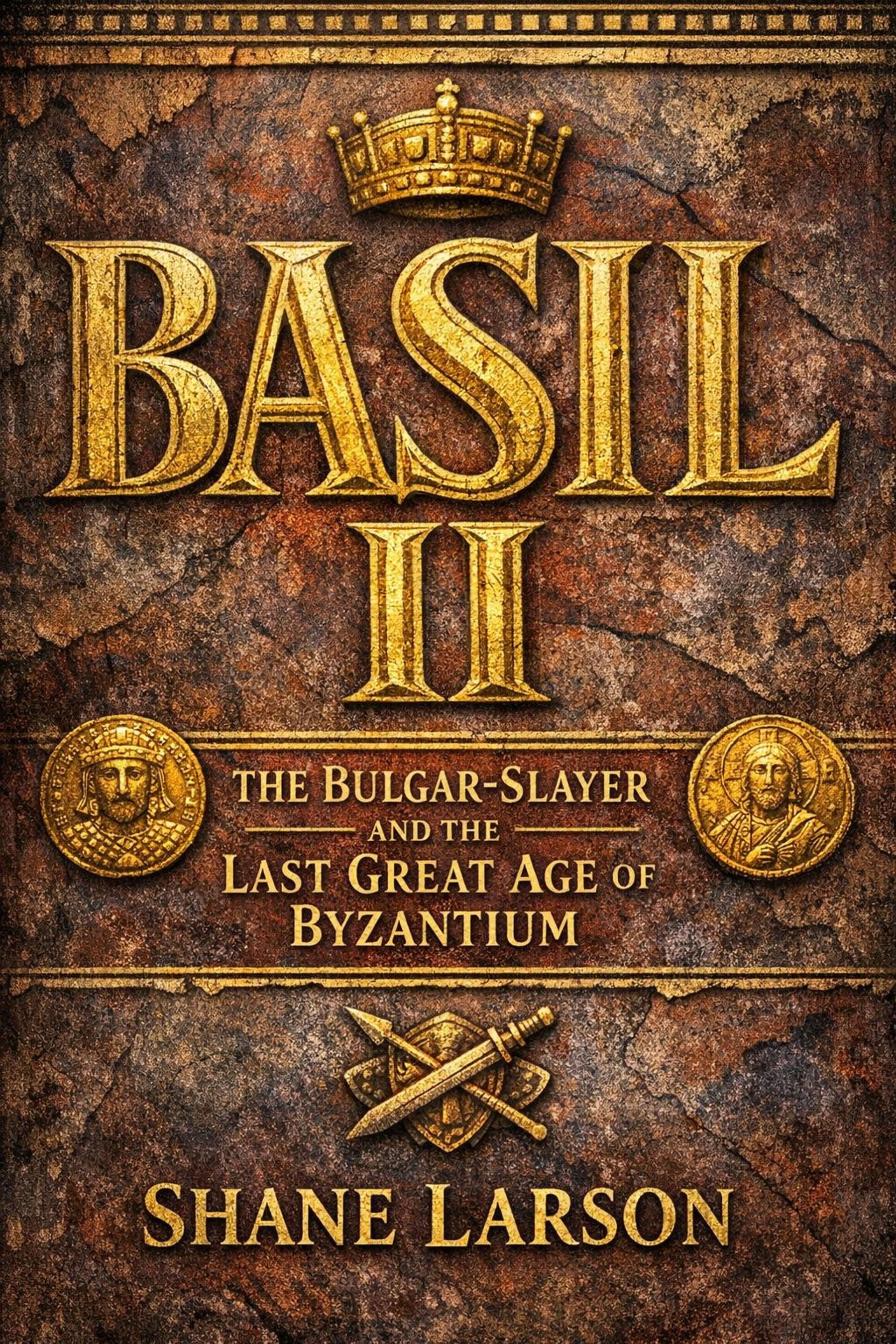
*Basil II: The Bulgar-Slayer and the Last Great Age of Byzantium* tells that whole life from the writers who recorded it, says how long after the events each one wrote, and gives Kleidion a full chapter in which the evidence on both sides is laid out.
Basil II
New posts and releases, straight to your inbox. No spam, unsubscribe anytime.