The Labyrinth Had a Budget: A Jar of Honey From Knossos, Seven Centuries Before Theseus
October 25, 2026 · 7 min read
Somewhere around 1400 BC, a clerk at Knossos pressed a stylus into a damp slip of clay and recorded a delivery of honey. The tablet is a few inches across, about the size of a page torn out of a notebook, and it was never meant to last. It survived because the building it was stored in burned, and the fire that destroyed the archive baked the clay hard enough to wait three and a half thousand years in the ground.
It is catalogued as KN Gg 702, and it has two lines. The first records one amphora of honey for all the gods, pa-si-te-o-i. The second records one amphora of honey for da-pu₂-ri-to-jo po-ti-ni-ja: the Mistress, or the Lady, of the Labyrinth.
That is the whole document. Nobody on it is a hero. Nothing on it is killed. It is an inventory entry, written in an early form of Greek by a working administrator, and its tone is the tone of every receipt ever written. One jar here, one jar there. The clerk did not explain who the Mistress of the Labyrinth was or where her labyrinth could be found, because the clerk did not need to. Everyone who was ever going to read the tablet already knew.
I spent a book on what that clerk did not bother to explain, and the thing I want to set out here is the smallest and firmest part of it: what a receipt can prove, and what it cannot.
The myth is younger than the paperwork
Here is the order of events, which almost nobody has in their head.
The Theseus story, the one with the tribute of young Athenians, the monster with the bull's head, the maze, and the ball of thread, does not appear in any surviving literature until roughly seven centuries after that clerk sat down to work. When it does appear it is told by Athenians, about Athens, during the century in which Athens was inventing itself as a democracy and an empire. The labyrinth in it is a prison, built by a foreign king to hold his wife's monstrous child. Theseus is the Athenian prince who goes in and comes out. The story is evidence about Athens first and Crete second, and the early chapters of the book spend some time on what the Athenians were using it for.
But on the tablet, at Knossos itself, long before any of that, the labyrinth is already something else. It belongs to a goddess. It receives offerings. It has, in the most literal and least romantic sense available, a budget line.
So the one thing the myth seems to have invented, the labyrinth, is the one thing it demonstrably did not. The word was in use at Knossos, attached to a deity, while the palace was still a working building. The Greeks who later told the Theseus story inherited the word from somewhere, and that somewhere was on this hill.
That is the firm part. Everything after it gets softer, and it is worth being honest about where.
What the receipt cannot tell you
A receipt is a wonderful kind of evidence precisely because it has no agenda. Nobody writes a jar of honey into the accounts to make a point. But that same indifference is its limit.
The tablet cannot tell you where the labyrinth was. It cannot tell you whether the labyrinth was a building, a shrine, a dancing floor, a cave, or simply a word for the palace itself. It cannot tell you whether anyone was ever sent into it, or whether anything was ever kept there. It cannot even tell you, on its own, what the word meant; the connection to the double axe, the labrys that is cut into the palace masonry and stamped on its pottery, rests on a reported Lydian word and a suffix that linguists have been arguing over for a century, and the book gives that argument both of its sides.
What the tablet can do is fix a point in time and a kind of thing. In roughly 1400 BC the people running Knossos used a word that sounds like labyrinth, treated it as the property of a goddess, and sent her honey. Whatever else it was, it was institutional. It was on the books.
A few other scraps sit in the same neighbourhood and are worth knowing, because together they begin to look like a pattern rather than a coincidence. The real city of Knossos, in the classical and Hellenistic centuries, put a labyrinth on its coins, as if it were the civic badge. Homer, who otherwise barely touches the Theseus story, mentions a dancing floor at Knossos that the craftsman Daedalus made for Ariadne, and he puts it on the shield of Achilles, which is a strange place for a Cretan detail to end up unless the detail was old and famous. A tablet from Pylos on the mainland has a labyrinth pattern scratched into its back, a doodle by someone who had the shape in their head. None of those is a plot. All of them are the residue of something that existed before the story that explains it.
The House of the Double Axe
Nobody could read it for fifty-two years
The man who dug the honey tablet out of the ground never knew what it said.
Arthur Evans bought the hill at Knossos and began excavating in March 1900. He had come to Crete looking for a script, and he found one within weeks, in thousands of clay tablets. He also found, which he had not expected, a palace. He named the civilization "Minoan," after the king in the myth, before a single tablet had been read, which bound the archaeology to the legend before anyone could check whether the legend had any business being there. He spent the remaining four decades of his life trying to read the script, and he believed to the end that it was not Greek. He died in July 1941.
The decipherment came eleven years later, and it is a story with its own book in the Peak Grizzly catalog, *Linear B*, so I am going to leave it there. What matters here is the result. Within a few years of 1952, the two lines of KN Gg 702 had been read, and the word Evans had attached to the building before the first spade went in turned out to have been sitting in his own finds trays since the first season. A clerk had called something at Knossos the labyrinth three thousand years before he did. They were never able to compare notes.
I find that episode is the shape of the whole subject in miniature. The evidence was there. The means of reading it was not. And in the gap, people built. The Athenians built a story. Evans built a palace, in reinforced concrete, over the ruin he had found, and a significant fraction of what a million visitors a year photograph at Knossos was made between 1922 and 1930. Each of those is a memory of the labyrinth, made by people who could not read the receipt.
The one thing everyone knows, which is the one thing that was never true
There is a last point, and it is the one the tablet makes room for.
Ask anyone what a labyrinth is and they will tell you it is a maze: branching corridors, wrong turns, dead ends, a place you can get lost in. That is why Theseus needs the thread. The thread is a tool for a building where the way back is a different problem from the way in.
But the labyrinth the ancient world actually drew, on the Pylos tablet, on the coins of Knossos, on Roman mosaic floors and much later on the pavement of Chartres cathedral, has no wrong turns at all. There is one path. It goes in by a route that doubles back and seems, repeatedly, to be heading away from the centre, and then it reaches the centre, and then, because there is only one path, it comes out again by the same route reversed. Nobody needs a thread in that labyrinth. What they need is the willingness to keep walking when the path seems to be going the wrong way.
The maze, the branching puzzle, is a late idea. The book follows it to the Renaissance garden and the moment at which a word for a sacred pattern became a word for a game. The clerk's labyrinth was not a trap. It was a place a goddess owned, and on an ordinary day in the Bronze Age somebody sent her a jar of honey and wrote it down. Everything else that has ever been said about the labyrinth, the monster, the tribute, the thread, the thousand rooms, the concrete, is what people made of that word on its way to us.
The receipt was the least important document in the building. It is also the one that tells the truth.
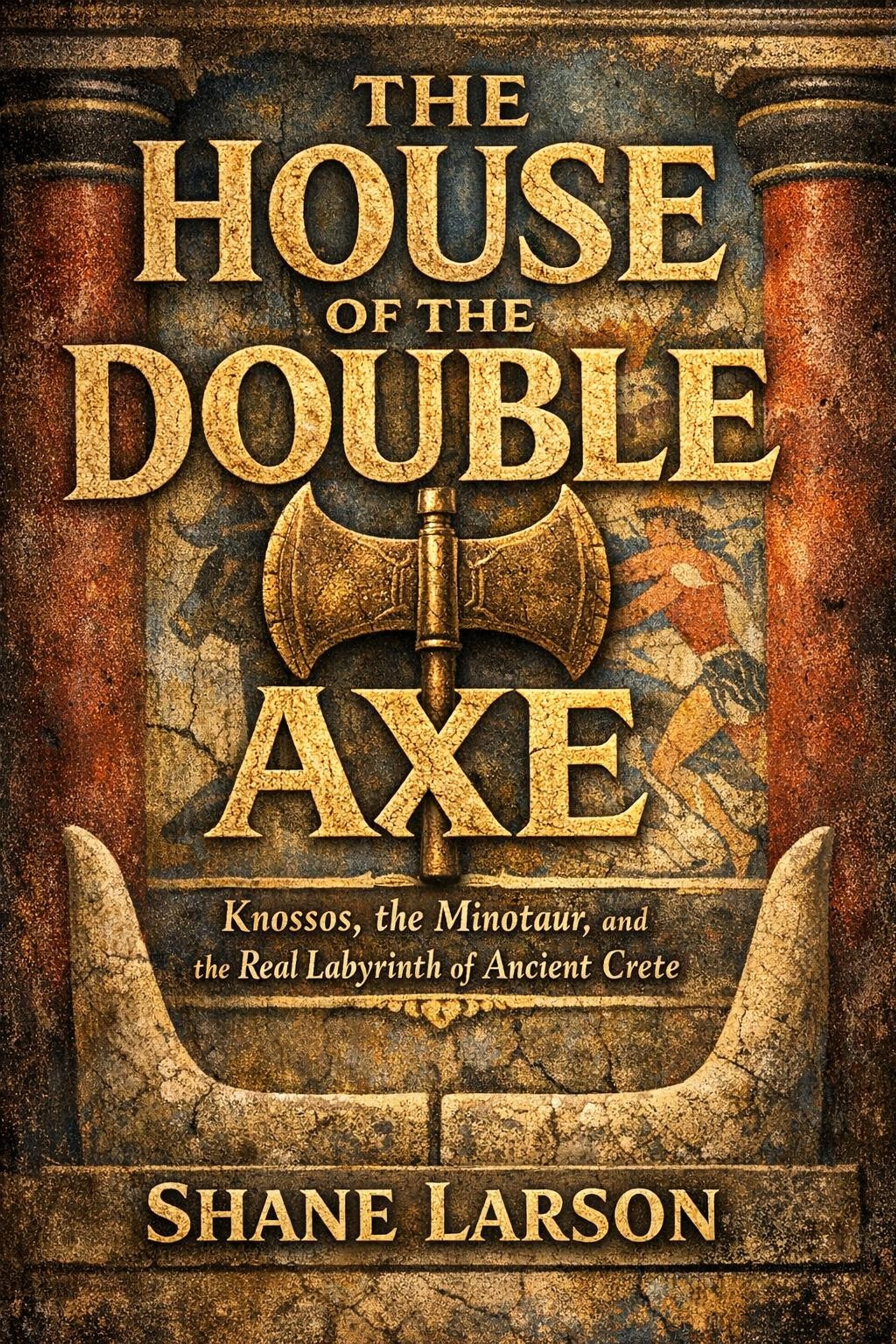
*The House of the Double Axe: Knossos, the Minotaur, and the Real Labyrinth of Ancient Crete* is available now in ebook and paperback from Apple Books, Kobo, Barnes & Noble and other retailers. It is the companion volume to the Minoan arc, alongside *The Minoans*, *Thera* and *Atlantis*, and it reads cold for anyone arriving from the myth. It takes the Theseus story, the palace and the man who dug it up as one subject, and it tells you at every point what was found and what was made.
The House of the Double Axe
New posts and releases, straight to your inbox. No spam, unsubscribe anytime.