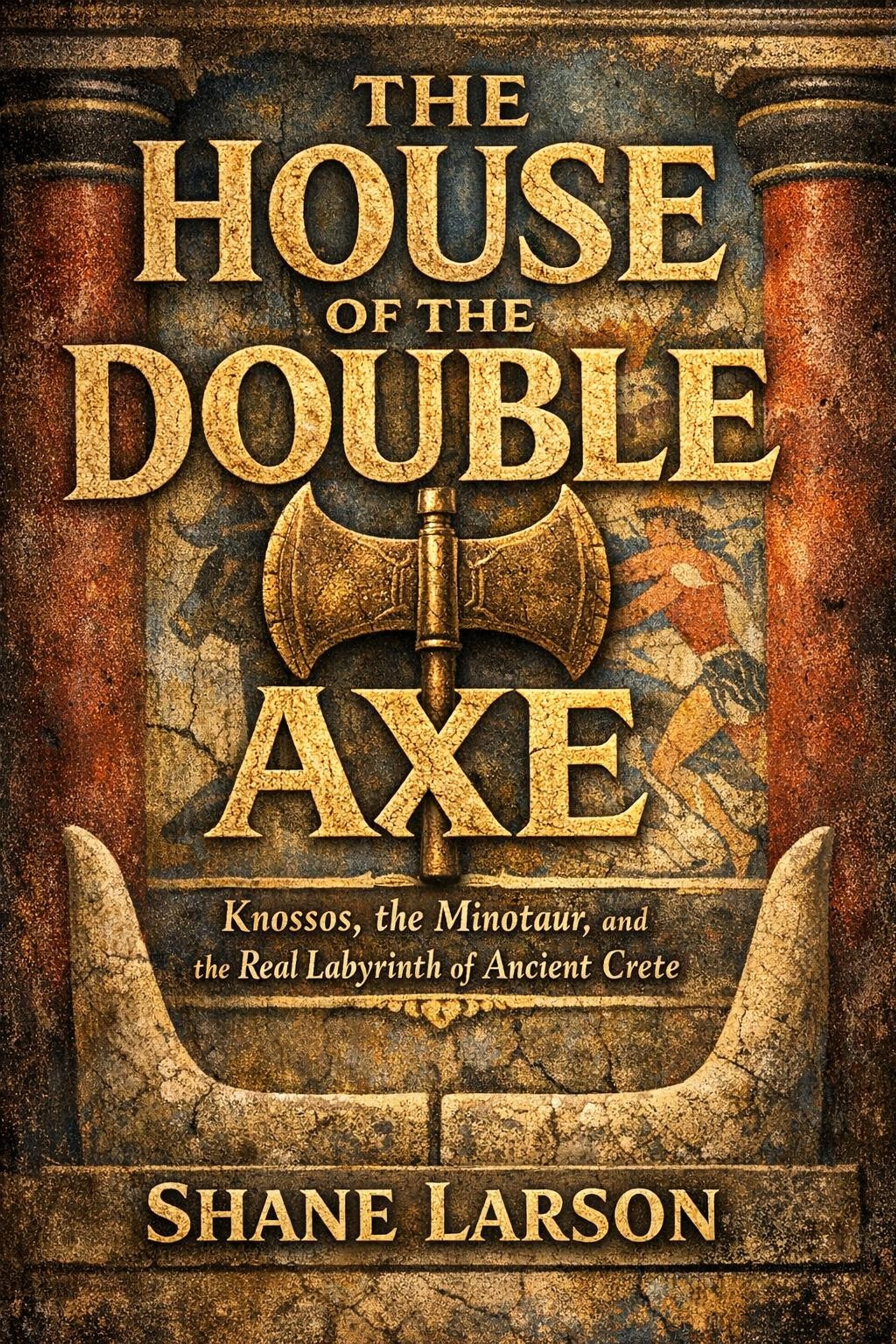
The House of the Double Axe
Knossos, the Minotaur, and the Real Labyrinth of Ancient Crete
By Shane Larson · The Bronze Age Collapse Chronicles (Book 13)
About This Book
Walk up the north side of Knossos on a summer morning and the first thing the camera finds is a portico of fat red columns, wider at the top than the bottom, holding up a slab of roof over a painted bull. It is the photograph on half the postcards in Heraklion. It is also concrete. The columns, the roof and the placement of the bull were put there in the 1920s by an English archaeologist who was sure he knew what had stood on that spot and decided to show everyone.
He was not a fraud, and he was not always wrong. But the gap between what came out of the ground at Knossos and what was built on top of it afterwards is one of the best stories in archaeology, and almost nobody standing in front of those columns is told it.
That gap is where the Minotaur lives too. The most famous myth in Greece is set in a building you can still visit, and both the myth and the building have been rebuilt so many times that it takes real work to see either one plainly.
The Myth, the Palace and the Man Who Dug It
The story the Greeks told is stranger than the one children learn. Athens sends young men and women to Crete as tribute; Theseus goes among them, kills the creature in the maze with help from the king's daughter Ariadne, and then leaves her asleep on an island on the way home. His father, watching for a white sail, sees a black one and throws himself to his death. And when you lay the ancient versions side by side, Ariadne starts to look less like a princess than a goddess who was written down to fit the story.
The palace is a different kind of puzzle. Knossos covers about five acres of storerooms, light wells, staircases, workshops and drains, and it never had a defensive wall. Its plan confuses visitors for an ordinary reason: centuries of rebuilding over the top of earlier rooms, after earthquakes and fires, until the whole thing became a warren. A clerk in that building wrote down a jar of honey for the Mistress of the Labyrinth on a clay tablet, long before anyone wrote the story of Theseus. The word, at least, was real.
The House of the Double Axe: Knossos, the Minotaur, and the Real Labyrinth of Ancient Crete works the seam between those two things, and then brings in the third: Arthur Evans, who bought the hill in 1900, gave the civilization the name "Minoan" after the king in the myth, and then rebuilt parts of the palace in reinforced concrete. The book follows him without contempt — what he got right, what he restored, what he invented — and then follows the scholars who spent a century checking his work.
Why I Wrote This
I had written about the Minoans, then the Thera eruption, then Atlantis, and every one of those books kept walking past the same building and the same monster without stopping. Readers know Theseus and the Minotaur from childhood. Very few know that the building is real, that its own records mention a labyrinth, or that a good part of what they photographed there was poured in the 1920s.
What hooked me was how fair you have to be to everyone involved. The Greeks who told the story were not lying, they were explaining their own past. Evans was not a vandal, he was a man trying to make a ruin legible. The interesting question is how each of them got from the evidence to the thing they built — and how far a reader can follow them before the evidence runs out.
Frequently Asked Questions
Was the labyrinth at Knossos real?
Partly. There was never a maze built to trap a monster, but a Bronze Age clerk at Knossos recorded offerings to a goddess called the Mistress of the Labyrinth, so the word was attached to something real on that hill. The book argues that the sprawling, much-rebuilt palace is the most likely thing later Greeks remembered as a labyrinth, and it shows where that argument is strong and where it is only a reading.
How much of Knossos is reconstructed?
A noticeable part of what visitors see, including the famous red columns and several restored upper storeys, dates from Arthur Evans's reconstructions in the 1920s and early 1930s. The book and its site guide mark what is original, what is restored and what is Evans's interpretation, area by area.
Is the Minotaur based on a real event?
No one can show that it is. The book sets out the case that the myth preserves a distorted memory of Minoan Crete — the bulls, the wealth, the huge building — and gives equal weight to the case that Athens invented the story for its own purposes, then says plainly where the evidence stops.
Do I need to read The Minoans first?
No. This is the side door into the Minoan arc and is written to stand alone. If you have read The Minoans, you will recognise Knossos and the frescoes, but here they are approached from the myth and the excavation rather than from the civilization as a whole.
Does it explain how Linear B was deciphered?
Only briefly, by design. This book covers what the Knossos tablets say; the full story of how they were cracked is the subject of a separate book in the catalog, linked below.
If You Liked This, You Might Like
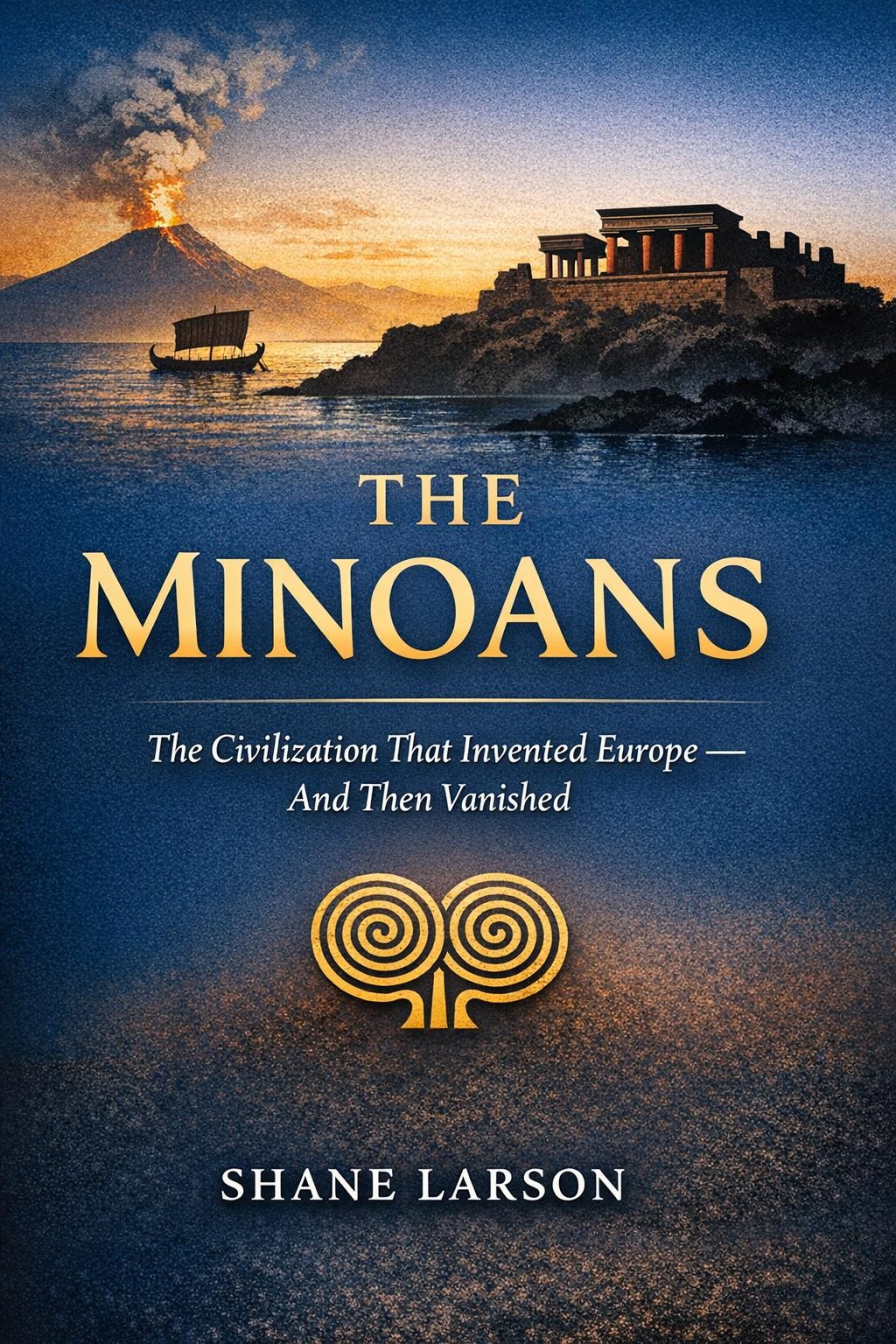
- The Minoans — the civilization that built the palace, its art, trade and sea power, and the arc this book belongs to.
- Linear B — how the tablets this book reads were finally deciphered, and the three people who did it.
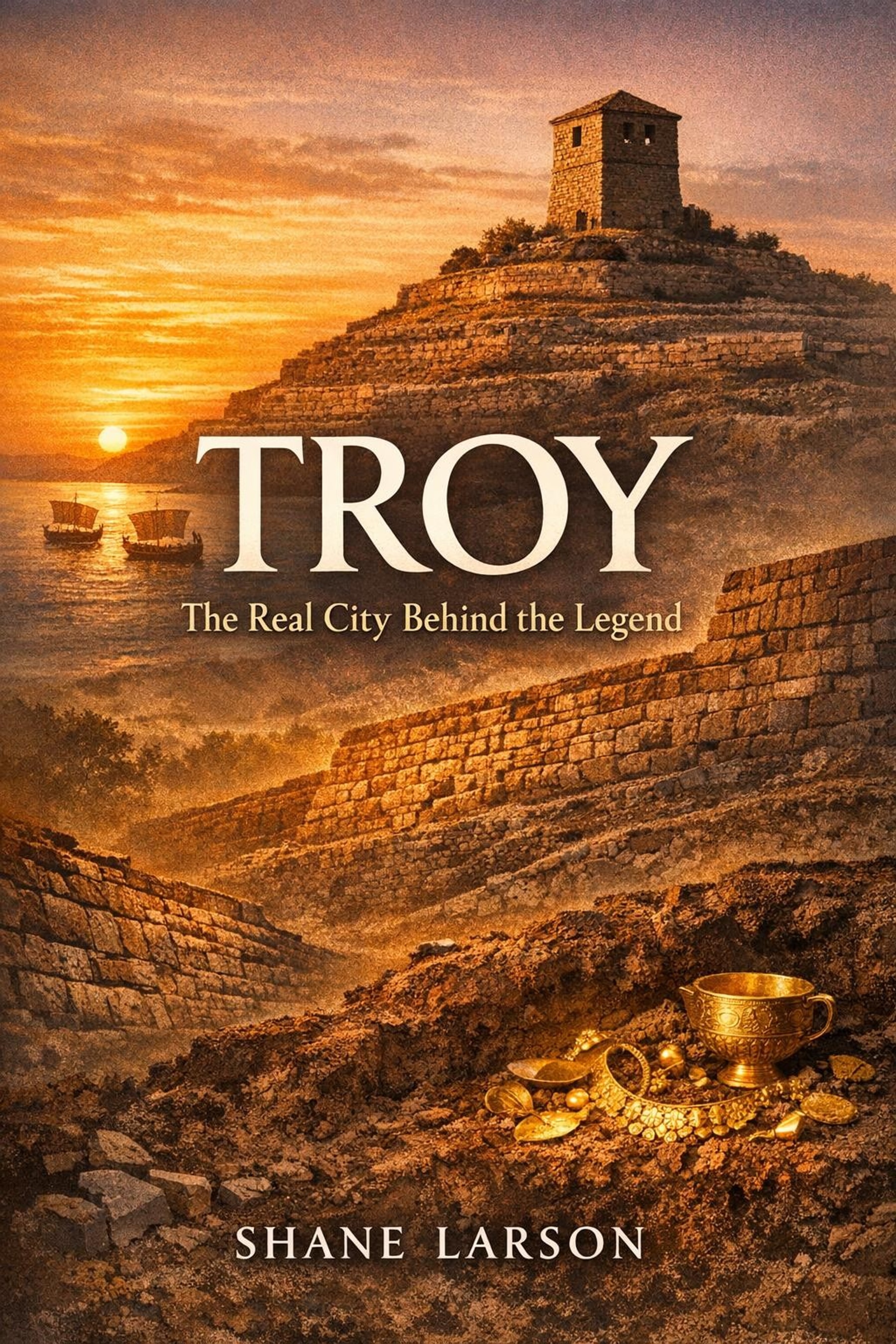
- Troy — the same question asked of another legend: a real city, an excavator with a theory, and a story that outgrew the evidence.
- Thera — the volcano that struck the Minoan world a century or more before the palace at Knossos fell.
The Minotaur's maze was never a building. The building was real, its paperwork named a labyrinth, and the man who dug it rebuilt what he hoped he had found. This book separates the three.
Companion volume to the Minoan arc in The Bronze Age Collapse Chronicles.
What You'll Learn
- **Paperwork older than the myth.** The Knossos tablet that records honey for the Mistress of the Labyrinth, and what the palace archive actually counts — sheep by the tens of thousands, wool, chariots, offerings to the gods.
- **The ancient versions of the story, compared.** Where Plutarch, Ovid, Catullus and the others agree, where they contradict one another, and how much of the tale is Athens telling its own history.
- **A maze with no wrong turns.** The labyrinth the Greeks actually drew has only one path, all the way in and back out. Why the puzzle-maze is a much later idea.
- **The double axe.** Where the *labrys* appears across Minoan Crete, why the word may or may not lie behind "labyrinth," and why linguists still argue about it.
- **The bull-leapers, honestly.** What the famous fresco shows, how much of it is original, and whether anyone could really vault a charging bull.
- **The darker evidence.** The hardest finds from Minoan religion, each presented with the excavators' reading and the critics' objections side by side.
- **Found versus made.** A visitor's key to what is Bronze Age and what is 1920s, from the Throne Room to the fresco first restored as a boy that turned out to be a monkey.
- **How a discipline audits its founder.** Wace, Blegen, Palmer and the modern re-excavation of Evans's own trenches and notebooks.
- **The labyrinth after Crete.** Roman mosaics, cathedral floors, hedge mazes, Borges and Picasso — two thousand years of a symbol.
New Ancient History releases and free chapters — no spam, unsubscribe anytime.
More in The Bronze Age Collapse Chronicles
View series →