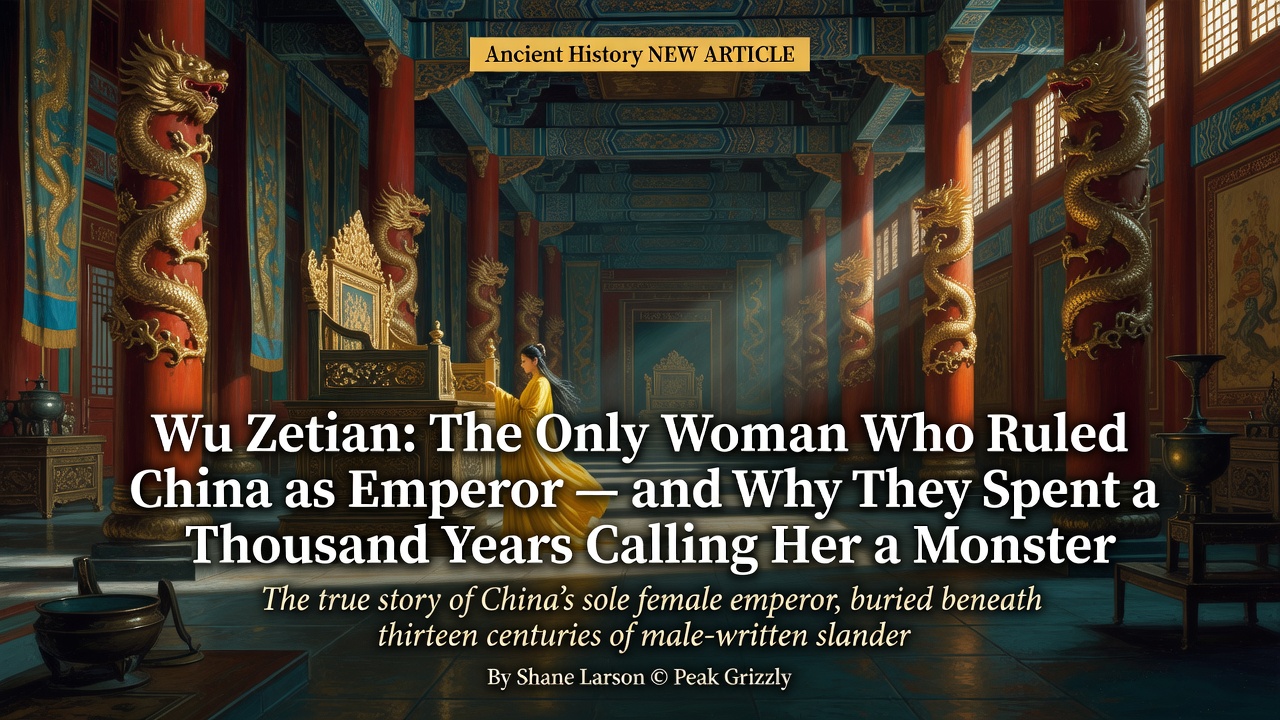
Wu Zetian: The Only Woman Who Ruled China as Emperor — and Why They Spent a Thousand Years Calling Her a Monster
August 4, 2026 · 7 min read
For roughly thirteen centuries, one woman has been the answer to a trivia question — the only female Emperor in Chinese history — and almost everything you've been told about her was written by men who thought she shouldn't exist.
That sentence contains the whole problem, and the whole reason I wrote a book about her.
Wu Zetian lived from 624 to 705 CE. In more than two thousand years of recorded Chinese history — dynasties rising and falling, hundreds of rulers, endless intrigue — she is the only woman who took the title of Emperor in her own name. Not empress consort. Not dowager. Not regent ruling on behalf of a boy. Emperor. The same title, the same word, the same claim to the Mandate of Heaven that the men held. Chinese political thought had long held that the ruler stood as the link between heaven and earth; when that ruler was female, the link itself was treated as broken.
She did it once, in the year 690, when she founded her own dynasty and called it the Zhou. And no woman in the thirteen hundred years since has ever done it again.
You'd think a fact that startling would make her one of the most studied, most celebrated figures in world history. Instead, for most of that time, she was a warning. A cautionary tale. The woman who proved why women should never be allowed near power. Understanding why is the most interesting thing about her — more interesting, even, than how she got the throne in the first place. And how she got the throne is already an extraordinary story.
From concubine to convent to the throne
Wu Zetian entered the imperial palace as a teenager — around the age of fourteen — as a low-ranking concubine of Emperor Taizong, one of the great rulers of the early Tang dynasty. Low-ranking is the operative phrase. There were a lot of concubines. Most of them never came close to real influence, and when an emperor died, the custom was brutal in its tidiness: his concubines who hadn't borne him sons were packed off to a Buddhist convent to live out their lives with shaved heads, removed from the world. The practice kept the palace from becoming a center of competing maternal factions once the new emperor took over.
When Taizong died, that's exactly where Wu went.
It should have been the end of the story. It's where almost every other woman in her position disappears from the record entirely. But Wu had, before Taizong's death, caught the attention of his son — the future Emperor Gaozong. After Gaozong took the throne, she came back to the palace. What happened next is one of the most consequential rises in the history of any court.
She moved from returned concubine to favored consort to empress, displacing Gaozong's existing empress along the way. This is where the sources turn darkest. The histories record that Wu's infant daughter died, and that Wu engineered the blame to fall on her rival, the reigning empress — some versions imply Wu killed the child herself to frame her. I spend real time in the book on what the evidence for this actually supports, because it's the single most damning charge against her and also the one most likely to have been sharpened, or invented, by later hostile historians. The honest answer is uncomfortable: we don't fully know, and the people who told us were not neutral. What is clear is that Gaozong's first empress was removed, stripped of title, and eventually killed, while Wu took her place.
What's clear is that she won. She became empress, and as Gaozong's health declined over the following years, she increasingly ran the empire in fact if not in name. When he died, she ruled through her sons — installing them, controlling them, and eventually pushing them aside. Then, in 690, she stopped ruling through anyone. She took the title herself.
What a competent monster looks like
Here's the part that makes Wu Zetian genuinely hard to write about, and genuinely worth writing about.
She was, by a great deal of evidence, very good at the job.
Under her rule, the imperial examination system — the meritocratic exams that let men enter government service based on demonstrated ability rather than aristocratic birth — was expanded and strengthened. She added new subjects, increased the frequency of testing, and made the process more open to men from outside the capital's established circles. This was not a small thing. It chipped away at the entrenched power of the old great families and broadened the base of talent the state could draw on. It's one of the reasons some modern historians argue she was among the more effective rulers of her era, full stop, gender aside.
Wu Zetian
She held a vast empire together for decades. She patronized Buddhism on a massive scale — including, by tradition, the colossal Vairocana Buddha at the Longmen Grottoes, whose face is said to echo her own features — and she did so in part because Buddhism gave her something Confucianism never would: a religious framework in which a woman ruling as a sovereign could be presented as legitimate, even foretold. That was shrewd statecraft. A woman claiming the throne in a Confucian world needed a different source of authority, and she found one.
And alongside all of that, she ran a secret police. She encouraged a network of informers. She presided over purges of the Tang imperial Li clan and of officials she saw as threats, and the cruelty of some of those years is not seriously in dispute. People died because she found them inconvenient. The scale of the repression rose and fell with the level of actual resistance she faced; it was not constant, but it was real.
So which was she? The competent reformer or the ruthless tyrant? The frustrating, honest answer is that she was both, and that almost every ruler who survives a half-century at the top of a pre-modern empire was both. We just don't usually demand that a single label resolve the contradiction — unless the ruler is a woman.
The men who wrote her down
This is where the historiography matters, and where I think the book earns its keep.
Nearly every source we have on Wu Zetian was written by Confucian scholar-officials, either during the later Tang or in the dynasties that followed. Confucian political philosophy had a very clear view of women and power: the proper order of the universe placed the husband above the wife, the father above the family, the male sovereign above all. A woman on the throne wasn't just a political problem. It was a cosmic offense — a sign that the natural order had been inverted, that yin had usurped yang. The historians who followed her therefore had a ready-made script: any successful policy could be credited to her male advisors, while any repression proved her innate cruelty.
So when these historians sat down to record Wu Zetian's reign, they weren't approaching a neutral subject. They were explaining a catastrophe. Every cruelty got amplified. Every ambiguous death became a murder she ordered. Her sexuality became a weapon used against her, in ways male rulers with far larger harems never faced. The competence got minimized; the monstrosity got the ink. Later dynasties, eager to restore the Tang as the legitimate line, had every reason to keep the portrait dark.
For a thousand years, that was the official Wu Zetian. It's only relatively recently that historians — working with the same limited sources but reading them against the grain, asking who wrote them and why — have reconstructed a more plausible figure: a brilliant, ambitious, often ruthless politician who was neither the demon of Confucian legend nor the feminist hero some modern accounts would prefer. The truth lives in the gap between those two portraits, and that gap is where I tried to put the reader.
The blank stone
Wu Zetian left one final puzzle. At her tomb stands a stele — a large stone monument of the kind normally carved with an inscription cataloguing the deceased ruler's virtues and achievements. Hers is blank. The Wordless Stele.
Nobody knows for certain why. Maybe she felt her accomplishments were too great to capture in words. Maybe it was an act of humility, or defiance, or a calculated refusal to let the usual formulas define her. Maybe she left judgment to posterity, knowing posterity would not be kind. The blank stone has become a kind of Rorschach test, and everyone who looks at it sees the Wu Zetian they already believed in.
I find that fitting. A woman whose entire historical reputation was written by people determined to misread her left behind one surface they couldn't write on at all.
Read the whole story
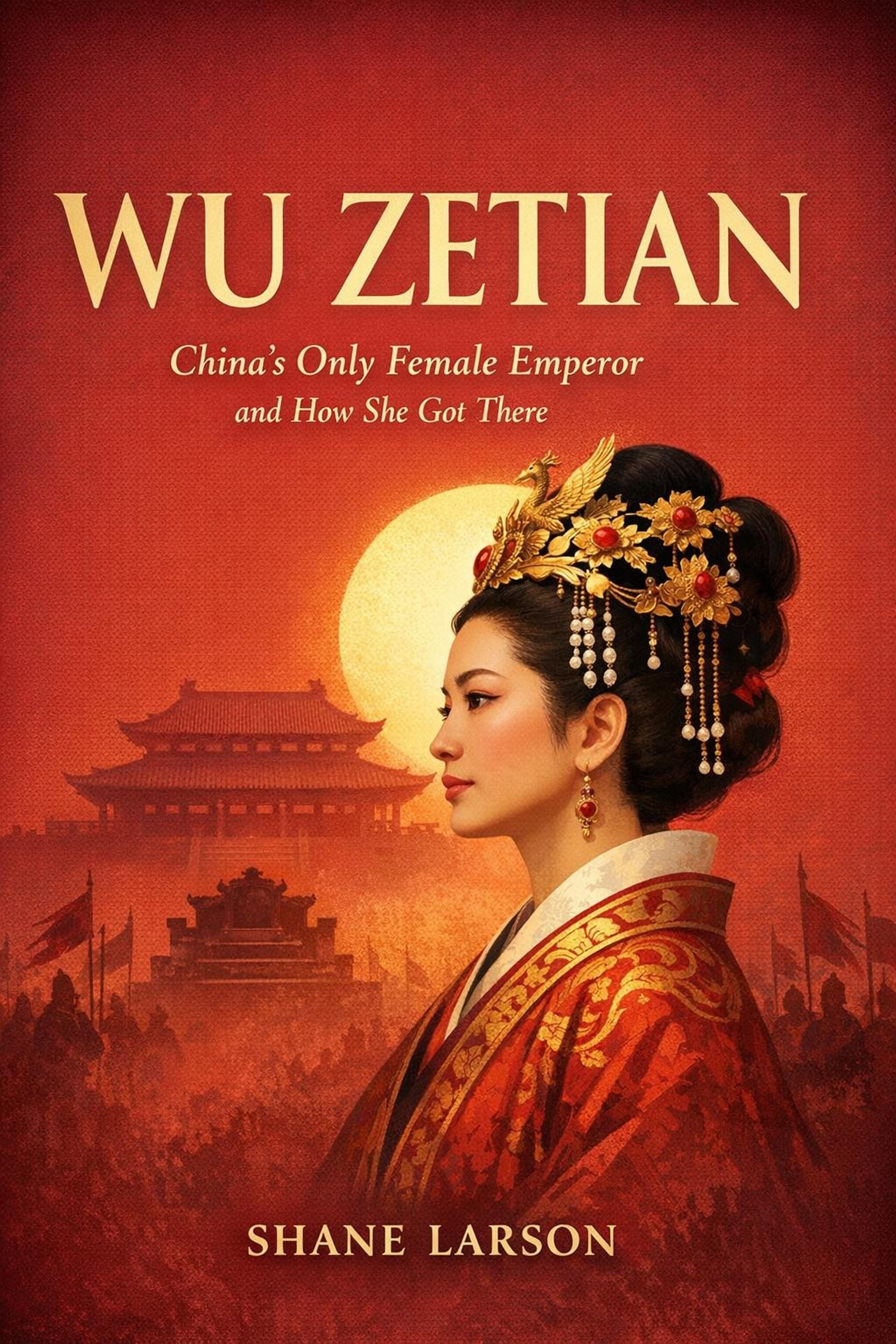
Wu Zetian: China's Only Female Emperor and How She Got There is out now — a narrative biography that follows her from the concubine's quarters to the throne and tries to tell the truth about a life that was buried under a thousand years of hostile spin. It's the latest in my ongoing series on the powerful women of the ancient world, alongside my books on Cleopatra, Hatshepsut, Nefertiti, Zenobia, Boudica, and Theodora.
If you want more on how I approach writing these lives — and why I keep coming back to women the historical record tried to erase — the rest of the catalog is here.
She was the only one. She deserves to be read on the evidence.
Wu Zetian
New posts and releases, straight to your inbox. No spam, unsubscribe anytime.