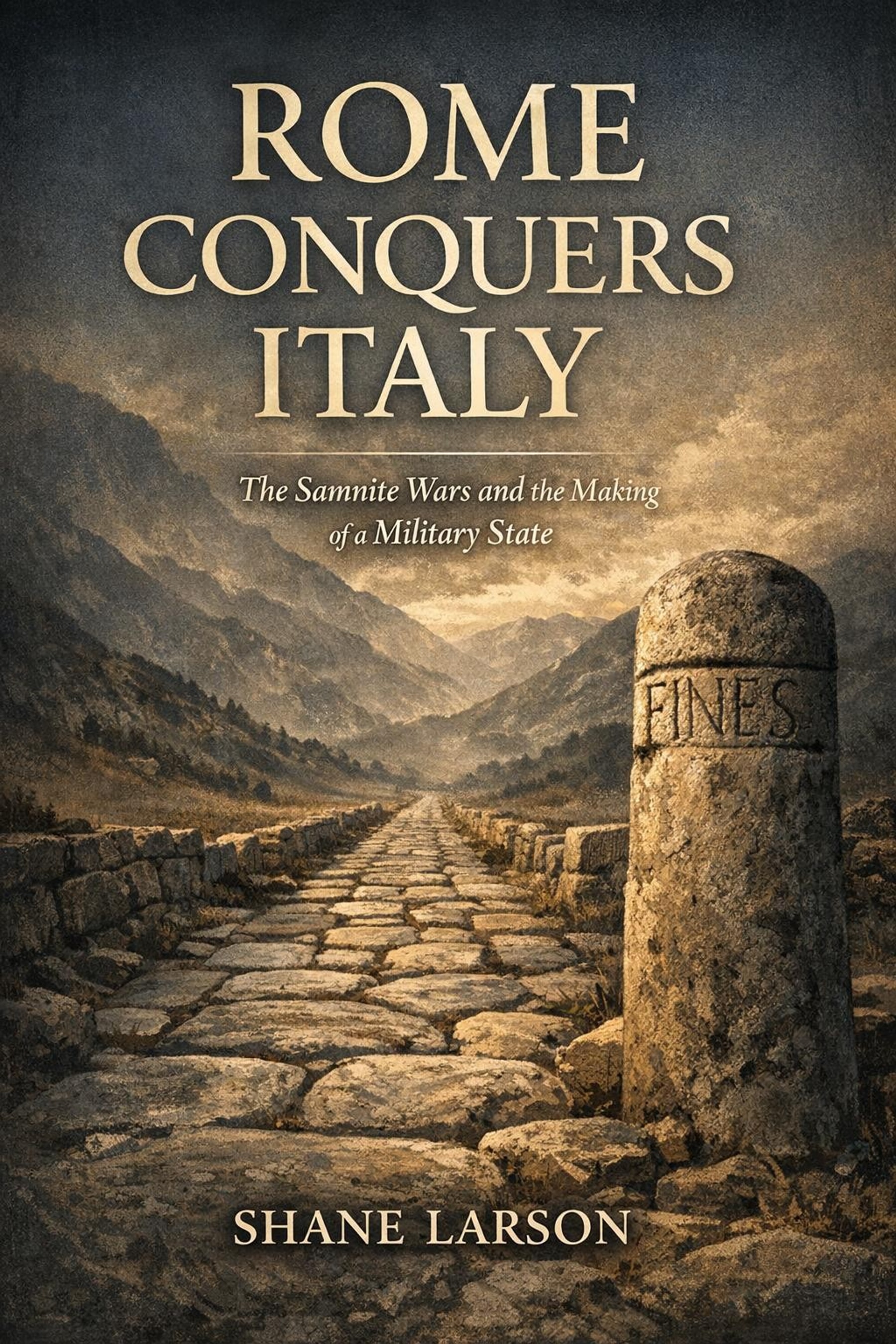
Rome Conquers Italy
The Samnite Wars and the Making of a Military State
By Shane Larson · Rome: From Village to Empire (Book 3)
About This Book
In the summer of 321 BC, two Roman consuls marched both consular armies — most of the field strength of the Roman state — into a mountain valley in Samnite country. The exit ahead was blocked: felled trees, piled boulders, armed men on the heights. So, they discovered, was the entrance behind them. Nobody charged down the slopes. Nobody had to. The Samnite commander had not fought a battle; he had closed a door, and the Roman army stood in a meadow, eating through its packs.
The army surrendered. Six hundred aristocratic hostages rode into the hills, and every Roman soldier, stripped to a single garment, stooped under a yoke built of spears — set deliberately low, so no man could pass under it upright. Then Rome went home, repudiated the agreement its own consuls had sworn, and kept the war.
Thirty years later, Samnium had no field army left. Seventy years later, Rome controlled every people in Italy south of the Po and was loading an army onto ships for Sicily. The men who marched under the yoke belonged to a middling city-state burned to the ground by a Gallic war band within living memory; their grandsons belonged to the most formidable military power in the Mediterranean. This book is about what happened in between.
The argument runs through a single year: 338 BC. Rome had just defeated the Latins — its own oldest allies — and every ancient precedent said what came next: massacre, enslavement, tribute, garrisons. Rome did something stranger. It dissolved the Latin League and went down the list of defeated towns writing different terms for each one: full Roman citizenship for some, citizenship without the vote for others — a citizen's burdens, including military service, without the ballot — Latin rights for the colonies, an individual treaty for everyone else. And underneath the whole arrangement ran one cold clause: the subject communities were forbidden to intermarry, trade, or assemble with one another. Every road ran through Rome. There was never a second Latin War, because the parts required to build one had been legally abolished.
That was the lock. The other half was a ladder. The statuses were not castes; they were rungs, and the rungs were reachable. Communities really did climb — half-citizens of 338 held the full franchise within decades, and one promoted hill town would eventually send Rome both Marius and Cicero. What the arrangement bought Rome was manpower: every status on the menu carried an obligation to send soldiers, and the total became a military resource no rival could match — the reason, decades later, that Hannibal could win every great battle and still lose the war.
But the machine had a bottom rung, and this book refuses to look away from it. Samnium was too strong to absorb on Rome's terms and declined to be a junior partner, so across three wars Rome broke it: land confiscated by the district, populations moved, the cantons of the league split apart, colonies driven into the conquered country like nails. The Samnites got the obligations and the troop schedules and no realistic prospect of climbing. Absorption was never generosity — it was rationed by what Rome could get away with — and the wrecked hill country of Samnium is as much the product of this century as the citizenship ladder. A book that showed only the clever half would be lying.
What's Inside
- The Latin War of 340–338 and the settlement that followed it — the most consequential administrative act in Roman history, examined gear by gear.
- The Samnites reconstructed from the ground up: an Oscan-speaking league of four cantons with no capital to take and no surviving literature, known almost entirely through the people who destroyed them.
- The Caudine Forks in full — the valley nobody has ever securely located, and the old man whose chillingly accurate advice nobody took.
- How the Roman army was redesigned around the enemy that beat it: the phalanx abandoned, the manipular legion built for broken ground.
- Appius Claudius Caecus — censor, road-builder, aqueduct-builder, blind and still dominant — the first Roman whose actual political programme is recoverable.
- Sentinum, 295 BC, the largest battle yet fought in Italy, and the ritual self-sacrifice of Decius Mus, treated as the religious act it was.
- The end of Samnium on the archaeological evidence: field surveys, emptied valleys, silent hill forts — the closest thing to Samnite testimony that will ever exist.
- Pyrrhus of Epirus, war elephants in Italy, and the victories that cost more than defeat — where the phrase everyone knows actually comes from.
Why I Wrote This
Every popular account of Rome I have ever picked up does the same jump: Romulus, some kings, the Republic founded — and then suddenly it is Hannibal at the gates, or Caesar at the Rubicon. The century in which Rome actually became Rome falls into the gap, and the gap bothered me for years, because it hides the answer to the best question in Roman history: how a burned town of thirty thousand people became a state that could lose army after army and keep fighting. It also bothered me who else falls into the gap. The Samnites fought Rome for fifty years, beat it repeatedly, forced the redesign of its army — and left no books. Everything we know about them was written by their destroyers. They deserved a volume that takes them seriously.
Frequently Asked Questions
Who were the Samnites?
A confederation of Oscan-speaking peoples in the southern Apennines — four cantons in a league rather than a city-state, which made them genuinely hard to fight because there was no capital to capture. They defeated Rome more than once and forced the redesign of its army, but left no surviving literature, so the book reconstructs them from archaeology, inscriptions, and Roman sources read against the grain.
What actually happened at the Caudine Forks?
In 321 BC both Roman consular armies followed planted false intelligence into an enclosed valley, and the Samnites blocked both exits without fighting a battle. The trapped army surrendered, gave hostages, and was marched under a yoke of spears. Rome then repudiated the sworn agreement and continued the war. The book gives the aftermath — the legal argument for breaking the deal — as much attention as the trap.
What is a Pyrrhic victory?
Pyrrhus of Epirus, hired by the Greek city of Tarentum, beat Rome twice — at Heraclea and Ausculum — losing veterans he could not replace against an enemy that replaced its losses easily. A victory that costs the winner more than it gains him has carried his name ever since. The final part of the book covers the whole war, elephants included.
Do I need to read the earlier books in the series first?
No. Each volume stands alone. The introduction recaps the background a new reader needs in a few pages, and everything else is supplied as the story goes.
How much can we actually know about this period?
Less than a smooth narrative would suggest. Livy's continuous account breaks off at 292 BC, so the last forty years rest on fragments and late summaries, and Roman family records demonstrably padded the victory lists. The book keeps the registers separate — what the tradition says, what Livy reports, what the archaeology shows — so you always know what kind of claim you are holding.
If You Liked This, You Might Like
- The Etruscans — the power that dominated Italy before Rome, whose cities fight on nearly every side of this book's wars.
- Hannibal's War — the direct sequel in historical terms: the alliance system built in this book is the reason Hannibal's victories did not end the war.
- The Last Days of Carthage — where the collision this book sets up on its final page ultimately ends, told from the other side of the water.
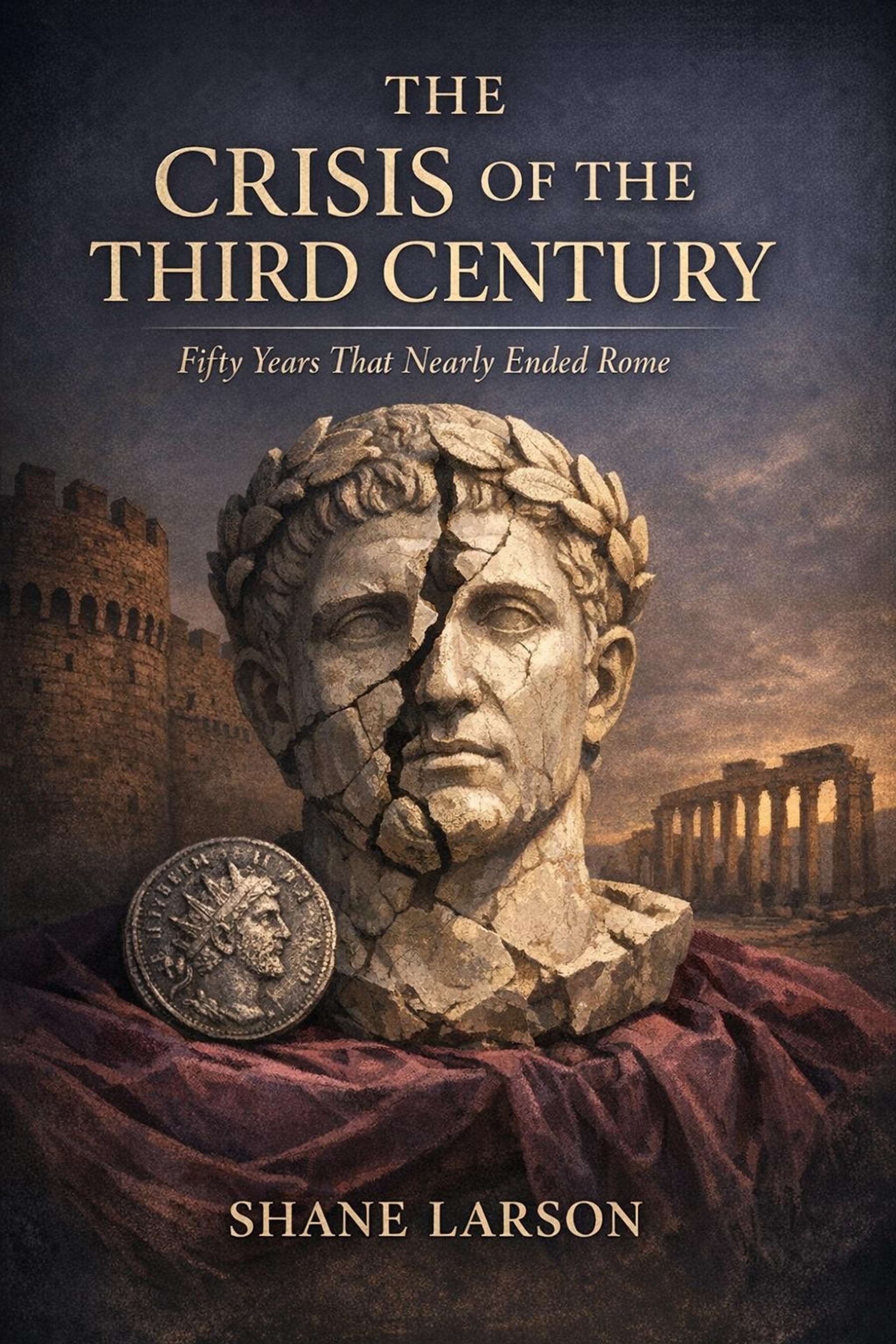
- The Fall of Rome — the far end of the arc: how the state whose construction this book describes eventually came apart.
The century between the ashes of 390 and the ships of 264 is where Rome was actually made. This book tells that story whole — clever half and brutal half together.
Rome: From Village to Empire, Book Three.
Included with Kindle Unlimited — read it free if you're a member.
New Ancient History releases and free chapters — no spam, unsubscribe anytime.
More in Rome: From Village to Empire
View series →